

/
RSS Feed
Welcome to The Complete Angler, your source of information on the outdoor industry in Central Canada.
With over 35 years in the field, host Don Lamont covers topics and issues with industry leaders and influencers to bring you up to speed on what’s happening in the outdoor world.
And now, here is your host, Don Lamont.
On this week’s episode, we visit with guide and adventurer, Tomasz Burlaga.
Born in Poland, he moved to Winnipeg when he was 10 with his mother.
Fishing and traveling the world is his passion.
He just finished his sixth season of guiding the God’s Lake and is getting ready to head back to Australia.
He will return to his job as a dive master and snorkel guide on the Great Barrier Reef.
Hey, Tomasz. Welcome to The Complete Angler podcast. Great to have you on.
Hey, Don. Thanks for having me.
Yeah, I heard about you through the grapevine.
One of the guys that I play golf with, he said, you got to talk to this guy.
He’s made his career out of guiding and not only fishing, but wild adventures in Australia.
So, first of all, I’d like to ask you, how did you get into the fishing game?
Well, to begin with, my father owned a fishing store and was a tournament fisher back in Poland when I was very, very young.
So, I got into it when I was two years old.
Then when I was 10 years old, I moved to Canada with my mom and still continued the fishing.
Always went out to White Shell and continued to fish throughout my youth.
And then as I graduated high school, I thought, what a perfect time.
Let’s apply to all these different fishing lodges that Canada has to offer.
So, I applied to about 25, 30 of them and had seven replies almost right away.
And my first one was Gauze Lake, Elk Island Lodge, and had an interview with him.
And he kind of made it a taker or leave a deal.
Greg did.
And I did have a few other interviews scheduled on Aikens Lodge and I think Wollaston Lake Lodge.
And at the end, I think I even had plumbers as well.
But I already accepted the offer with Elk Island Lodge and I have no regrets with that.
It’s such a beautiful lake in northern Manitoba, untouched wilderness and such big fish there.
So, it’s really an amazing place.
So, I’m really happy I got into guiding.
I spent six years up there in total and really, really enjoy it there.
Now, for people that aren’t aware, I mean, there’s so many different lodges in this part of the world.
And that’s one lake I’ve never been to, God’s Lake, believe it or not.
I’ve seen and heard a lot about it.
So, tell us, do you have any wild stories from your six years up there?
I don’t know about wild, but there’s the brook trout fishing.
That’s one thing that really I always think about when I go up there, they have real big brook trout.
There’s a river that flows out of the lake.
It’s called the God’s River and flows all the way up north to the Hudson Bay through Shimadawa and the Hayes River.
And it’s got some amazing beautiful rapids.
So, when I first started there, I started as a shore boy for the first month or two.
And then I worked my way up to the guide, as almost all the people do when you become a guide.
And then it was always my passion.
I want to make it out to the brook trout river.
I want to make it out.
And then it took me one more year.
And then he finally sent me up there because it’s very, very shallow, very rocky.
You need to have perfect boat control to shoot up the rapid.
But if you don’t, you’re going to hit a rock and take a blade off.
So, I really honed in on the art of working the river and really, really enjoyed it up there.
Big brook trout up to 25, 26 inches we got up there.
I think three, four years ago, we got a, not my boat, but the boat beside me got a 26-incher up there.
Yeah, it is absolutely a world-class brook trout fishery, without a doubt.
But there’s other big fish in that lake as well, Tomasz.
Pike and lake trout?
Oh, the pike fishing is incredible.
This year, I got lucky.
We had a nine-trophy pike day.
It was incredible.
We went out to a little fly-out lake we have.
It’s called Chadaway Lake.
It is connected to God’s Lake.
And we really don’t fly, don’t fish that lake much in the weed bed season, as we haven’t had good luck.
But I was there about four years ago and had somewhat good luck near the end of the day.
We got into two-trophy pike and a big-trophy walleye, right near the end of the day, half an hour left of the day.
And I marked that spot on my portable fish finder.
And I had these guests from New York, New Jersey.
They wanted big pike.
The weather wasn’t so good on God’s Lake.
It was kind of a transition period.
The weed beds weren’t up yet fully on the lake.
But we were getting into a lot of pike, about 100 pike, 150 pike, but nothing in that 37, 38 range, like consistently, like they wanted.
So I kind of convinced them to do the fly-out.
We went up there and nailed the pike, nine-trophy pike over 41 inches.
And they were just ecstatic.
So that was a really, really good day.
What we usually use out there is little five-of-diamonds for them.
You don’t really need big baits up there.
A lot of people think you need a big bait, which they do.
They do work big bulldogs, big paddle tails.
But this year, most of the trophies were caught on very, very small five-of-diamonds boons, actually, that day.
And throughout the whole time.
On God’s Lake as well.
I got a 44-incher on the fly with my second-last guest.
So that was a beautiful fish.
And quite a few 45s this year as well.
A lot of nice-sized pike.
But it’s just, I kind of almost take it for granted.
It’s just so many good bays.
It’s such a big, big lake.
It’s always easy to find big pike on that lake.
And the lake trail fishing as well.
It’s something else on the lake.
Yeah, I’ve heard that.
Were the water conditions, was the water up just like everywhere else in Manitoba?
The season, it started very, very low, actually.
Not the lowest I’ve seen it, but quite low.
And it was rising at such a rapid rate.
And near the end of the season, just when I left, it was the highest I’ve ever seen it and highest anyone’s ever seen it.
So throughout the whole summer, it rose over four and a half feet.
Four and a half to close to five feet up there.
What kind of challenges does that present to the lodge owner and the docks and everything else?
With Greg, we had to move the dock quite a few times.
And a few days, we’d come back and a storm would kick in and just push all the water against the shoreline as well.
And we would almost have to boat the guests up to the rocks to drop them off.
And then we had to adjust the dock with the staff because we were all working out on the boat, on the water the whole day.
So we had to do it after work.
Obviously, fix the dock and then it’d be ready for the next week or two.
And then the water would rise again and we’d have to move it again.
Yeah, there’s been a lot of challenges everywhere because of the high water.
But overall, in the long term, that’s great for everything.
The resource, the fishery, just makes everything so much healthier, doesn’t it?
Oh, yeah.
High water year, I always have heard that it really helps the walleye spawn, helps them get up further in the rivers and just produces quite a good spawn for the walleyes.
So in about eight to 10 years up there, there’s going to be some big, big trophy walleyes from this year’s spawn.
Yeah, it certainly does.
It doesn’t hurt the pike population as well.
I heard from a lot of people, though, this year, because of the high water and the flooded vegetation, the pike were kind of hard to pinpoint in most cases.
Did you find that?
Yeah.
Yeah, there was that, as I was talking about earlier, there was that transition period because the water was so high, the weed beds didn’t develop in most of the bays that they usually do.
So there was only maybe two or three constant weed beds this year, as opposed to normal year where you got 15, 20 bays that you can consistently go to.
You know there’s going to be some big pikes there.
They’re going to be concentrated there.
This year, there was maybe about three, and they were just on opposite sides of the lake.
So it would be really, you got to drive 45 minutes this way, 35 minutes this way, and depending on the wind, it made it quite challenging to really get some, get the guys on a big bike, especially if it was windy.
But as the season went on near August, some of the other bays did develop the weeds, but they just didn’t come up all the way to the surface like they usually do, just because the water was so, so high.
Right, right, right, some of the challenges of being a guide, as you have to be able to adjust to what the fish do, what the conditions are, and I think that’s what makes it such a great challenge as a guide.
It’s the everyday having to adjust and find it, because you’re getting paid, right?
You have to find your guest’s fish.
You do, you do.
Talk about that a little bit.
I’ve always made it a goal of mine to always make sure we catch fish.
I know a lot of people, they say, we just want the big one, we just want the big one, and I do take them to spots that the big ones are in, but I always make sure the guests have to catch fish.
And the challenge is, yeah, with the water conditions being different, the wind, the wind direction, sometimes blowing into favorable bays where they’ve been biting, you just got to find other spots to get the fish, to get the guests on fish comfortably.
And it is a bit of a challenge, you wake up in the morning, some days you look out there, it’s so windy, and the guests, they’ve paid a lot of money to come up fishing, and you just really have to think, dig deep and think, where are these fish going to be?
What kind of bait are they going to be chasing, what kind of lures, and it’s a challenge some days, but that’s what we get paid for.
So, exactly.
As I mentioned to you earlier, we were talking about, I started as a guide on the Winnipeg River at Eagle Nest Lodge in 1982, and it’s certainly, river situations are always ever-changing, and you have to be able to adjust.
I just got back, actually, Tomasz, from a flying trip, outpost trip with my family, and the first day we got there, the walleye fishing was absolutely on fire, and then the second day, I kind of cooled off a little bit, and then I noticed on, you know, I always bring a portable depth finder, as you should, on any fishing trip.
I noticed that the fish were off the bottom a little bit, then I noticed there was a mayfly hatch, and so the third day, or last day, we got the ned rigs out with, you know, like a crayfish imitation, like a ned rig, and we ended up catching fish.
So, I mean, that’s just an example of spending time on the water enables you to kind of find what works faster.
It doesn’t happen all the time, but at least you have a chance of figuring it out.
So, but anyway, you’re home for a couple weeks, and then you’re back off to Australia, I understand.
Tell us about that experience, and how you ended up in Australia the first time.
Well, I’ve been always traveling, in between doing this summer job at Elk Island Lodge, being a guide, I always went to university.
I would study geography and environmental science at University of Manitoba.
So, in between the season and the end of university, I always had about a month.
So, I always traveled somewhere, got into scuba diving, which I really, really loved, and just kind of ticked off continents and different countries.
And Australia was one of my last continents, besides Antarctica, to go travel to.
So, I’ve always been saving up, saving up to go there.
And it was just the perfect time.
I graduated university, had one more season up at God’s Lake, and just went out there at the end of 2019.
And it was beautiful.
I was traveling, diving along the whole East Coast, seeing all Australia had to offer.
And then, of course, the world shut down.
And the ticket was so expensive to come home.
It was about $10,000 just to come home.
And I had a job at the moment.
It was in the critical sector.
I was actually picking fruit to extend my visa for next year.
So, I was picking bananas, oranges, lions.
But that’s another story, all the spiders and snakes there.
But, yeah, I was doing that, and I just said, that’s too expensive.
I’ll just rough it out.
I thought it was going to – it wasn’t going to take that long.
I thought maybe a month, two, maybe three months, and then everything should be back to normal.
Ended up getting stuck out there for two and a half years, essentially.
Wow.
I was just able to come home May, May 22nd of this year.
And, yeah, Greg was always in touch.
Are you going to come up to Elk Island Laws?
I am one of his top guides and one of his favorite guides.
So, he’s always excited when I told him I’m coming back this year.
But you ended up doing some pretty wild stuff.
Talk about how you ended up guiding people on the Great Barrier Reef.
Oh, yeah.
I first started out in the northern part near Cairns.
I worked on a resort.
So, it was just a little bit of maintenance and a little bit of boat maintenance.
I helped the guests with some fishing offshore, actually, just for some coral trout, stuff like that.
Took them off for little snorkeling trips.
And it was a good job, but not exactly what I wanted to do.
I wanted to be in the water.
So, when I was doing that job for about a month, month and a half, I constantly applied for other jobs.
And I ended up getting one in the Whitsundays, which is one of the best areas of all of Australia.
It’s got the number one beach in the world, Whitsunday Beach, where they film Pirates of the Caribbean, Fool’s Gold.
A lot of the celebrities go there.
Chris Hemsworth has a house on the islands there.
And a lot of celebrities do go there.
So, I got a job there.
I was very, very excited.
I went up there.
They said, as well, with the dive boats coming in a few months, it’s just getting fixed down in Brisbane.
I started out as a snorkel guy.
So, I was in the water every day, taking people for a swim, showing them turtles, showing them sharks, just stuff like that.
Big fish, rays.
So, it was just awesome.
You’re getting paid to go swim around, take people’s pictures with a GoPro of fish, and just tell them quite a few facts about how the reef grows, and how everything works on the reef, and how it’s all just a circle of life.
The small stuff grows, the bigger fish come in to feed, and just how the coral spawn happens.
So, it was just incredible.
One wild adventure I could tell you on is this kind of just stays between us.
Well, it is a podcast, but we’re out on the reef.
We’re just with a big boat.
We have about 50 clients, and we’re going to just go and do a drift snorkel.
So, it’s essentially we’re on the edge of a reef.
It drops down to 25 meters, and then another ledge drops down to 45 meters.
That’s where you see the big stuff, the manta rays, the big eagle rays that are four, four and a half meters wide, and the bigger bull sharks and the odd tiger sharks.
So, we were making our way up there, and the captain says, I’ll talk, because that was the main tour guide that decides where we go.
And we just see a fin up there, and it was a big tiger shark.
And just from my experience, I have spent a year at that point already at the company.
I know in clear water, it’s not dangerous at all to be with a shark.
So, my skipper says, it’s your call.
Are we dropping people off, or are we going in or not?
And I said, yeah, let’s go in there.
And we went in there, and we seen, yeah, about a three and a half meter tiger shark.
I kind of saw him at first, and then he just got scared of us and took off.
But there was a bit of a scary move to make, but I was happy to make it just to swim with a tiger shark.
It’s such a beautiful fish, and it’s one moment I’ll never forget from working on the reef there.
Wow, great story.
So, are you going back?
I am going back.
I really miss it.
I’m happy I came back to Canada.
I’ve seen my family.
I do love it up there.
Fishing is incredible.
I haven’t even gotten to the fishing part in Australia.
I love it.
You go out there, it’s just a different kind of fish.
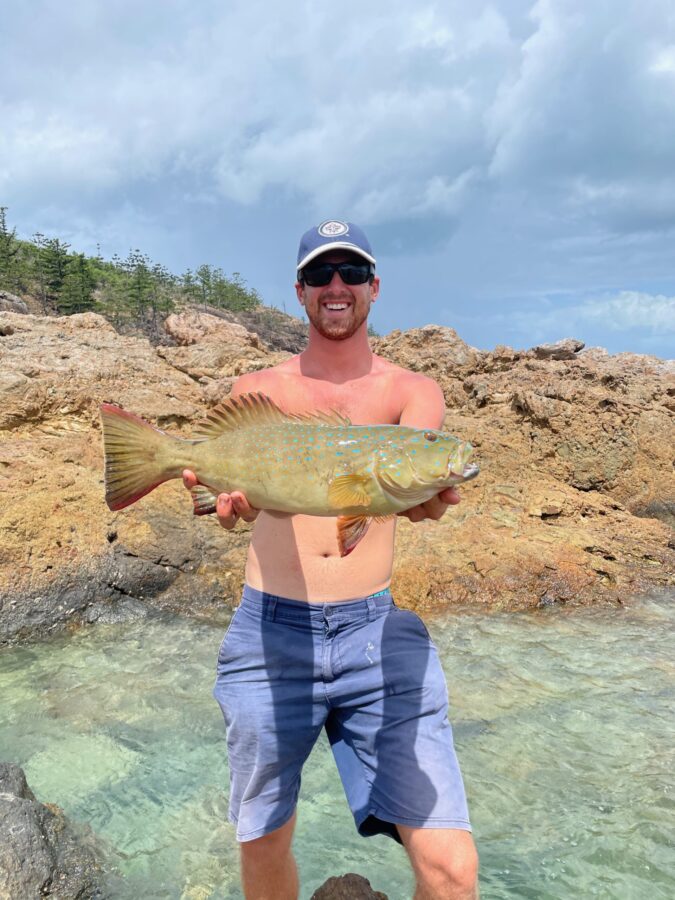
There’s a fish called the coral trout.
Maybe if I’m able to, I’ll email you some of these pictures.
There’s these fish that have dots just like brook trout, pretty much blue colors on them, nice and red, orange.
There’s incredible colors, and they taste just amazing.
Quite easy to catch.
They’re just on all the edges of the reefs.
They hide in the coral balmies, so you essentially just toss a little hook with a slip sinker and a sardine or a piece of anchovy, and it’s quite easy to get them.
And what I also have developed a passion for is spearfishing.
It’s a mix of fishing and hunting.
So, we go out there with a little spear gun.
We hold our breath, and then we swim, and we selectively choose which fish we want to take.
You swim up to them.
They’re not really shy at all, and it’s a good way just if you go after work,
I’d go out, just swim straight off the island and get a nice coral trout for dinner.
It would be a nice, healthy, easy way just to pick a fish that you want to eat.
I really got into that.
I’m sorry.
What size do these coral trout get to?
Oh, over a meter 20.
Meter 20 is a big, big coral trout.
Okay.
Trout is 5 to 70 centimeters.
That’s a really good trout.
Okay.
But they’re pretty thick.
They’re almost like a snapper-ish size, but a bit thicker.
Like a big southern smallmouth bass or a largemouth bass.
That thickness to them.
You’re making me hungry.
How do you prepare them?
Essentially, just almost like a walleye.
All the fish, I find, they’re almost the same to fillet.
They just take off the ribs, and they’ve just got the pin bones on the middle.
Yeah.
And that’s pretty much it.
They make nice fillets, and they deep fry them.
There’s a nice light coat of flour, cornflake crumbs, and a little bit of onion powder, paprika,
lemon pepper, pepper, and that’s it.
The fish just has so much flavor in itself, and it’s such a white, flaky meat.
It’s actually a very, very expensive fish as well.
It sits around $80 per kilo there in Australia.
Yeah.
And in some of the Asian markets, they sell for up to $300 for the certain.
There’s many different subspecies of the coral trout.
There’s probably about 15 different ones, but some of the subspecies sell for up to $300 a kilo.
So, Tomasz, what does the future hold?
Are you planning to do something with your degree?
To be honest, I think that’s more of a backup plan.
Now, I’m very happy I went to university.
I was going to become a conservation officer here in Manitoba and Northern Ontario.
I think they just developed a way of thinking, how the environment works, the geography, oceanography.
That’s all the stuff I kind of studied.
So, it all helped me with all these jobs.
Being a tour guide, I was able to talk about the reef and talk about the circle of life
and how all the landscapes developed to all my guests, which they really, really love.
And I always told them stories also about Canada and all that and just the fishing up in the north.
So, I think essentially, I would really like to open up my own fishing and diving business one day.
Ideally, in Australia, if it works out and with the possibility of maybe even having a lodge here in Canada one day as well.
Kind of a dual kind of market if it did work.
I think essentially, I’d like to have a diving and a fishing boat where we go out for a few days out to the Great Barrier Reef.
We sleep out on the reef.
I take people scuba diving for one, two days, teach them to do that.
And then we go out to the 100 meter, 1,000 meter mark and we troll for some marlin or get some big Spanish mackerel.
There’s the possibilities that are endless.
And everyone I’ve talked to about this idea says that there’s nothing else like that in the market at the moment,
having diving and fishing on the same boat.
So, I think that’s what I’m pushing for at the moment, saving up for that.
It’s going to take quite a few more years to buy a nice boat, big enough to do those kind of trips.
But that’s my dreams and that’s my goal.
I like to have big dreams.
I hope they come true.
That sounds like a great idea.
Before I let you go, I want you to tell me about your favorite Canadian fishing experience.
It could be a fish that you caught or something that you saw.
All right.
Is that a tough one?
There’s so many different stories that come to mind.
Maybe I’ll split it into two, if that’s okay.
Yeah.
So, there was this moment on God’s Lake about maybe my second or third season there.
We were just fishing some spots.
I was following some guys still as I didn’t know the lake all that well.
They were showing me some new spots.
I just stopped at all these kind of very nice beige rocks that just stood out to me.
And there was just big boulders in the middle of the lake.
I thought, oh, no, something for sure is going to be holding to their structure.
We pull up and I’ve seen the biggest pike I’ve ever seen.
I’ve gone into some 45, 46 pike on the lake.
And I mean, this pike was well, close to 50 for sure, if not over 50 inches.
And my guest didn’t have any polarized glasses, stood up.
And I’m like, cast to that fish.
Come on, please.
Just cast to it.
He’s like, where is it?
I don’t see it.
And then the fish spooked.
And I was just, I was in awe how big that fish is.
But I’m sure as a guide yourself, you know those moments.
You’re pointing at the fish.
You’re telling the guests, oh, there’s the big one.
And a lot of times they’re sitting down.
They’re not really paying attention.
So those moments do happen, but I’ll never forget that pike.
I still spent six seasons out there, never seen one close to that size.
Well, for sure in the 50-inch-plus range.
And then another favorite moment I would have probably have to have been this year.
I did a TV show.
I did the new fly fisher.
I was the guide for the new fly fisher.
Bill Spicer wasn’t the host.
He’s having, I think he’s having a break.
So I had Jeff Parks from Ontario.
He’s a guide himself, and he’s one of the new hosts.
So yeah, I spent eight days filming for pike and six days, oh no, eight days in total.
We spent two days on the lake for topwater pike and making pike action.
And then we spent six days on the river getting these big, beautiful brook trout for the show.
So it’s going to be airing actually in January or March this year, they said.
So I can’t wait to see how it all comes out.
I was actually quite involved in the show.
Giving a lot of tips and tricks and helping out quite a bit.
So I’m excited to see how they edit it and how it’s going to come out.
Definitely one of my highlights and a good way to finish it if I am done guiding here in Canada.
But you never know.
Okay.
Well, I look forward to seeing it.
And I’ll tell you what, when it does come out, we’re going to have a bio on the podcast.
I’ll put a link to it when it does come out so people can find it and that’d be great.
So I really thank you for coming on the show.
It was extremely interesting.
And I wish you all the best on your trip over to Australia.
And hopefully you won’t get stuck there for another three or four years.
Well, maybe that’s not a bad thing.
Yeah, we’ll see what life has to hold.
Thank you very much for having me.
This was an incredible opportunity.
And it was a pleasure chatting with you and meeting you.
All right.
Thanks so much, Tomasz.
Thanks for tuning in.
Visit HookedMagazine.com to subscribe to The Complete Angler and never miss an episode.
With over 35 years in the field, host Don Lamont covers topics and issues with industry leaders and influencers to bring you up to speed on what’s happening in the outdoor world.
And now, here is your host, Don Lamont.
On this week’s episode, we visit with guide and adventurer, Tomasz Burlaga.
Born in Poland, he moved to Winnipeg when he was 10 with his mother.
Fishing and traveling the world is his passion.
He just finished his sixth season of guiding the God’s Lake and is getting ready to head back to Australia.
He will return to his job as a dive master and snorkel guide on the Great Barrier Reef.
Hey, Tomasz. Welcome to The Complete Angler podcast. Great to have you on.
Hey, Don. Thanks for having me.
Yeah, I heard about you through the grapevine.
One of the guys that I play golf with, he said, you got to talk to this guy.
He’s made his career out of guiding and not only fishing, but wild adventures in Australia.
So, first of all, I’d like to ask you, how did you get into the fishing game?
Well, to begin with, my father owned a fishing store and was a tournament fisher back in Poland when I was very, very young.
So, I got into it when I was two years old.
Then when I was 10 years old, I moved to Canada with my mom and still continued the fishing.
Always went out to White Shell and continued to fish throughout my youth.
And then as I graduated high school, I thought, what a perfect time.
Let’s apply to all these different fishing lodges that Canada has to offer.
So, I applied to about 25, 30 of them and had seven replies almost right away.
And my first one was Gauze Lake, Elk Island Lodge, and had an interview with him.
And he kind of made it a taker or leave a deal.
Greg did.
And I did have a few other interviews scheduled on Aikens Lodge and I think Wollaston Lake Lodge.
And at the end, I think I even had plumbers as well.
But I already accepted the offer with Elk Island Lodge and I have no regrets with that.
It’s such a beautiful lake in northern Manitoba, untouched wilderness and such big fish there.
So, it’s really an amazing place.
So, I’m really happy I got into guiding.
I spent six years up there in total and really, really enjoy it there.
Now, for people that aren’t aware, I mean, there’s so many different lodges in this part of the world.
And that’s one lake I’ve never been to, God’s Lake, believe it or not.
I’ve seen and heard a lot about it.
So, tell us, do you have any wild stories from your six years up there?
I don’t know about wild, but there’s the brook trout fishing.
That’s one thing that really I always think about when I go up there, they have real big brook trout.
There’s a river that flows out of the lake.
It’s called the God’s River and flows all the way up north to the Hudson Bay through Shimadawa and the Hayes River.
And it’s got some amazing beautiful rapids.
So, when I first started there, I started as a shore boy for the first month or two.
And then I worked my way up to the guide, as almost all the people do when you become a guide.
And then it was always my passion.
I want to make it out to the brook trout river.
I want to make it out.
And then it took me one more year.
And then he finally sent me up there because it’s very, very shallow, very rocky.
You need to have perfect boat control to shoot up the rapid.
But if you don’t, you’re going to hit a rock and take a blade off.
So, I really honed in on the art of working the river and really, really enjoyed it up there.
Big brook trout up to 25, 26 inches we got up there.
I think three, four years ago, we got a, not my boat, but the boat beside me got a 26-incher up there.
Yeah, it is absolutely a world-class brook trout fishery, without a doubt.
But there’s other big fish in that lake as well, Tomasz.
Pike and lake trout?
Oh, the pike fishing is incredible.
This year, I got lucky.
We had a nine-trophy pike day.
It was incredible.
We went out to a little fly-out lake we have.
It’s called Chadaway Lake.
It is connected to God’s Lake.
And we really don’t fly, don’t fish that lake much in the weed bed season, as we haven’t had good luck.
But I was there about four years ago and had somewhat good luck near the end of the day.
We got into two-trophy pike and a big-trophy walleye, right near the end of the day, half an hour left of the day.
And I marked that spot on my portable fish finder.
And I had these guests from New York, New Jersey.
They wanted big pike.
The weather wasn’t so good on God’s Lake.
It was kind of a transition period.
The weed beds weren’t up yet fully on the lake.
But we were getting into a lot of pike, about 100 pike, 150 pike, but nothing in that 37, 38 range, like consistently, like they wanted.
So I kind of convinced them to do the fly-out.
We went up there and nailed the pike, nine-trophy pike over 41 inches.
And they were just ecstatic.
So that was a really, really good day.
What we usually use out there is little five-of-diamonds for them.
You don’t really need big baits up there.
A lot of people think you need a big bait, which they do.
They do work big bulldogs, big paddle tails.
But this year, most of the trophies were caught on very, very small five-of-diamonds boons, actually, that day.
And throughout the whole time.
On God’s Lake as well.
I got a 44-incher on the fly with my second-last guest.
So that was a beautiful fish.
And quite a few 45s this year as well.
A lot of nice-sized pike.
But it’s just, I kind of almost take it for granted.
It’s just so many good bays.
It’s such a big, big lake.
It’s always easy to find big pike on that lake.
And the lake trail fishing as well.
It’s something else on the lake.
Yeah, I’ve heard that.
Were the water conditions, was the water up just like everywhere else in Manitoba?
The season, it started very, very low, actually.
Not the lowest I’ve seen it, but quite low.
And it was rising at such a rapid rate.
And near the end of the season, just when I left, it was the highest I’ve ever seen it and highest anyone’s ever seen it.
So throughout the whole summer, it rose over four and a half feet.
Four and a half to close to five feet up there.
What kind of challenges does that present to the lodge owner and the docks and everything else?
With Greg, we had to move the dock quite a few times.
And a few days, we’d come back and a storm would kick in and just push all the water against the shoreline as well.
And we would almost have to boat the guests up to the rocks to drop them off.
And then we had to adjust the dock with the staff because we were all working out on the boat, on the water the whole day.
So we had to do it after work.
Obviously, fix the dock and then it’d be ready for the next week or two.
And then the water would rise again and we’d have to move it again.
Yeah, there’s been a lot of challenges everywhere because of the high water.
But overall, in the long term, that’s great for everything.
The resource, the fishery, just makes everything so much healthier, doesn’t it?
Oh, yeah.
High water year, I always have heard that it really helps the walleye spawn, helps them get up further in the rivers and just produces quite a good spawn for the walleyes.
So in about eight to 10 years up there, there’s going to be some big, big trophy walleyes from this year’s spawn.
Yeah, it certainly does.
It doesn’t hurt the pike population as well.
I heard from a lot of people, though, this year, because of the high water and the flooded vegetation, the pike were kind of hard to pinpoint in most cases.
Did you find that?
Yeah.
Yeah, there was that, as I was talking about earlier, there was that transition period because the water was so high, the weed beds didn’t develop in most of the bays that they usually do.
So there was only maybe two or three constant weed beds this year, as opposed to normal year where you got 15, 20 bays that you can consistently go to.
You know there’s going to be some big pikes there.
They’re going to be concentrated there.
This year, there was maybe about three, and they were just on opposite sides of the lake.
So it would be really, you got to drive 45 minutes this way, 35 minutes this way, and depending on the wind, it made it quite challenging to really get some, get the guys on a big bike, especially if it was windy.
But as the season went on near August, some of the other bays did develop the weeds, but they just didn’t come up all the way to the surface like they usually do, just because the water was so, so high.
Right, right, right, some of the challenges of being a guide, as you have to be able to adjust to what the fish do, what the conditions are, and I think that’s what makes it such a great challenge as a guide.
It’s the everyday having to adjust and find it, because you’re getting paid, right?
You have to find your guest’s fish.
You do, you do.
Talk about that a little bit.
I’ve always made it a goal of mine to always make sure we catch fish.
I know a lot of people, they say, we just want the big one, we just want the big one, and I do take them to spots that the big ones are in, but I always make sure the guests have to catch fish.
And the challenge is, yeah, with the water conditions being different, the wind, the wind direction, sometimes blowing into favorable bays where they’ve been biting, you just got to find other spots to get the fish, to get the guests on fish comfortably.
And it is a bit of a challenge, you wake up in the morning, some days you look out there, it’s so windy, and the guests, they’ve paid a lot of money to come up fishing, and you just really have to think, dig deep and think, where are these fish going to be?
What kind of bait are they going to be chasing, what kind of lures, and it’s a challenge some days, but that’s what we get paid for.
So, exactly.
As I mentioned to you earlier, we were talking about, I started as a guide on the Winnipeg River at Eagle Nest Lodge in 1982, and it’s certainly, river situations are always ever-changing, and you have to be able to adjust.
I just got back, actually, Tomasz, from a flying trip, outpost trip with my family, and the first day we got there, the walleye fishing was absolutely on fire, and then the second day, I kind of cooled off a little bit, and then I noticed on, you know, I always bring a portable depth finder, as you should, on any fishing trip.
I noticed that the fish were off the bottom a little bit, then I noticed there was a mayfly hatch, and so the third day, or last day, we got the ned rigs out with, you know, like a crayfish imitation, like a ned rig, and we ended up catching fish.
So, I mean, that’s just an example of spending time on the water enables you to kind of find what works faster.
It doesn’t happen all the time, but at least you have a chance of figuring it out.
So, but anyway, you’re home for a couple weeks, and then you’re back off to Australia, I understand.
Tell us about that experience, and how you ended up in Australia the first time.
Well, I’ve been always traveling, in between doing this summer job at Elk Island Lodge, being a guide, I always went to university.
I would study geography and environmental science at University of Manitoba.
So, in between the season and the end of university, I always had about a month.
So, I always traveled somewhere, got into scuba diving, which I really, really loved, and just kind of ticked off continents and different countries.
And Australia was one of my last continents, besides Antarctica, to go travel to.
So, I’ve always been saving up, saving up to go there.
And it was just the perfect time.
I graduated university, had one more season up at God’s Lake, and just went out there at the end of 2019.
And it was beautiful.
I was traveling, diving along the whole East Coast, seeing all Australia had to offer.
And then, of course, the world shut down.
And the ticket was so expensive to come home.
It was about $10,000 just to come home.
And I had a job at the moment.
It was in the critical sector.
I was actually picking fruit to extend my visa for next year.
So, I was picking bananas, oranges, lions.
But that’s another story, all the spiders and snakes there.
But, yeah, I was doing that, and I just said, that’s too expensive.
I’ll just rough it out.
I thought it was going to – it wasn’t going to take that long.
I thought maybe a month, two, maybe three months, and then everything should be back to normal.
Ended up getting stuck out there for two and a half years, essentially.
Wow.
I was just able to come home May, May 22nd of this year.
And, yeah, Greg was always in touch.
Are you going to come up to Elk Island Laws?
I am one of his top guides and one of his favorite guides.
So, he’s always excited when I told him I’m coming back this year.
But you ended up doing some pretty wild stuff.
Talk about how you ended up guiding people on the Great Barrier Reef.
Oh, yeah.
I first started out in the northern part near Cairns.
I worked on a resort.
So, it was just a little bit of maintenance and a little bit of boat maintenance.
I helped the guests with some fishing offshore, actually, just for some coral trout, stuff like that.
Took them off for little snorkeling trips.
And it was a good job, but not exactly what I wanted to do.
I wanted to be in the water.
So, when I was doing that job for about a month, month and a half, I constantly applied for other jobs.
And I ended up getting one in the Whitsundays, which is one of the best areas of all of Australia.
It’s got the number one beach in the world, Whitsunday Beach, where they film Pirates of the Caribbean, Fool’s Gold.
A lot of the celebrities go there.
Chris Hemsworth has a house on the islands there.
And a lot of celebrities do go there.
So, I got a job there.
I was very, very excited.
I went up there.
They said, as well, with the dive boats coming in a few months, it’s just getting fixed down in Brisbane.
I started out as a snorkel guy.
So, I was in the water every day, taking people for a swim, showing them turtles, showing them sharks, just stuff like that.
Big fish, rays.
So, it was just awesome.
You’re getting paid to go swim around, take people’s pictures with a GoPro of fish, and just tell them quite a few facts about how the reef grows, and how everything works on the reef, and how it’s all just a circle of life.
The small stuff grows, the bigger fish come in to feed, and just how the coral spawn happens.
So, it was just incredible.
One wild adventure I could tell you on is this kind of just stays between us.
Well, it is a podcast, but we’re out on the reef.
We’re just with a big boat.
We have about 50 clients, and we’re going to just go and do a drift snorkel.
So, it’s essentially we’re on the edge of a reef.
It drops down to 25 meters, and then another ledge drops down to 45 meters.
That’s where you see the big stuff, the manta rays, the big eagle rays that are four, four and a half meters wide, and the bigger bull sharks and the odd tiger sharks.
So, we were making our way up there, and the captain says, I’ll talk, because that was the main tour guide that decides where we go.
And we just see a fin up there, and it was a big tiger shark.
And just from my experience, I have spent a year at that point already at the company.
I know in clear water, it’s not dangerous at all to be with a shark.
So, my skipper says, it’s your call.
Are we dropping people off, or are we going in or not?
And I said, yeah, let’s go in there.
And we went in there, and we seen, yeah, about a three and a half meter tiger shark.
I kind of saw him at first, and then he just got scared of us and took off.
But there was a bit of a scary move to make, but I was happy to make it just to swim with a tiger shark.
It’s such a beautiful fish, and it’s one moment I’ll never forget from working on the reef there.
Wow, great story.
So, are you going back?
I am going back.
I really miss it.
I’m happy I came back to Canada.
I’ve seen my family.
I do love it up there.
Fishing is incredible.
I haven’t even gotten to the fishing part in Australia.
I love it.
You go out there, it’s just a different kind of fish.
There’s a fish called the coral trout.
Maybe if I’m able to, I’ll email you some of these pictures.
There’s these fish that have dots just like brook trout, pretty much blue colors on them, nice and red, orange.
There’s incredible colors, and they taste just amazing.
Quite easy to catch.
They’re just on all the edges of the reefs.
They hide in the coral balmies, so you essentially just toss a little hook with a slip sinker and a sardine or a piece of anchovy, and it’s quite easy to get them.
And what I also have developed a passion for is spearfishing.
It’s a mix of fishing and hunting.
So, we go out there with a little spear gun.
We hold our breath, and then we swim, and we selectively choose which fish we want to take.
You swim up to them.
They’re not really shy at all, and it’s a good way just if you go after work,
I’d go out, just swim straight off the island and get a nice coral trout for dinner.
It would be a nice, healthy, easy way just to pick a fish that you want to eat.
I really got into that.
I’m sorry.
What size do these coral trout get to?
Oh, over a meter 20.
Meter 20 is a big, big coral trout.
Okay.
Trout is 5 to 70 centimeters.
That’s a really good trout.
Okay.
But they’re pretty thick.
They’re almost like a snapper-ish size, but a bit thicker.
Like a big southern smallmouth bass or a largemouth bass.
That thickness to them.
You’re making me hungry.
How do you prepare them?
Essentially, just almost like a walleye.
All the fish, I find, they’re almost the same to fillet.
They just take off the ribs, and they’ve just got the pin bones on the middle.
Yeah.
And that’s pretty much it.
They make nice fillets, and they deep fry them.
There’s a nice light coat of flour, cornflake crumbs, and a little bit of onion powder, paprika,
lemon pepper, pepper, and that’s it.
The fish just has so much flavor in itself, and it’s such a white, flaky meat.
It’s actually a very, very expensive fish as well.
It sits around $80 per kilo there in Australia.
Yeah.
And in some of the Asian markets, they sell for up to $300 for the certain.
There’s many different subspecies of the coral trout.
There’s probably about 15 different ones, but some of the subspecies sell for up to $300 a kilo.
So, Tomasz, what does the future hold?
Are you planning to do something with your degree?
To be honest, I think that’s more of a backup plan.
Now, I’m very happy I went to university.
I was going to become a conservation officer here in Manitoba and Northern Ontario.
I think they just developed a way of thinking, how the environment works, the geography, oceanography.
That’s all the stuff I kind of studied.
So, it all helped me with all these jobs.
Being a tour guide, I was able to talk about the reef and talk about the circle of life
and how all the landscapes developed to all my guests, which they really, really love.
And I always told them stories also about Canada and all that and just the fishing up in the north.
So, I think essentially, I would really like to open up my own fishing and diving business one day.
Ideally, in Australia, if it works out and with the possibility of maybe even having a lodge here in Canada one day as well.
Kind of a dual kind of market if it did work.
I think essentially, I’d like to have a diving and a fishing boat where we go out for a few days out to the Great Barrier Reef.
We sleep out on the reef.
I take people scuba diving for one, two days, teach them to do that.
And then we go out to the 100 meter, 1,000 meter mark and we troll for some marlin or get some big Spanish mackerel.
There’s the possibilities that are endless.
And everyone I’ve talked to about this idea says that there’s nothing else like that in the market at the moment,
having diving and fishing on the same boat.
So, I think that’s what I’m pushing for at the moment, saving up for that.
It’s going to take quite a few more years to buy a nice boat, big enough to do those kind of trips.
But that’s my dreams and that’s my goal.
I like to have big dreams.
I hope they come true.
That sounds like a great idea.
Before I let you go, I want you to tell me about your favorite Canadian fishing experience.
It could be a fish that you caught or something that you saw.
All right.
Is that a tough one?
There’s so many different stories that come to mind.
Maybe I’ll split it into two, if that’s okay.
Yeah.
So, there was this moment on God’s Lake about maybe my second or third season there.
We were just fishing some spots.
I was following some guys still as I didn’t know the lake all that well.
They were showing me some new spots.
I just stopped at all these kind of very nice beige rocks that just stood out to me.
And there was just big boulders in the middle of the lake.
I thought, oh, no, something for sure is going to be holding to their structure.
We pull up and I’ve seen the biggest pike I’ve ever seen.
I’ve gone into some 45, 46 pike on the lake.
And I mean, this pike was well, close to 50 for sure, if not over 50 inches.
And my guest didn’t have any polarized glasses, stood up.
And I’m like, cast to that fish.
Come on, please.
Just cast to it.
He’s like, where is it?
I don’t see it.
And then the fish spooked.
And I was just, I was in awe how big that fish is.
But I’m sure as a guide yourself, you know those moments.
You’re pointing at the fish.
You’re telling the guests, oh, there’s the big one.
And a lot of times they’re sitting down.
They’re not really paying attention.
So those moments do happen, but I’ll never forget that pike.
I still spent six seasons out there, never seen one close to that size.
Well, for sure in the 50-inch-plus range.
And then another favorite moment I would have probably have to have been this year.
I did a TV show.
I did the new fly fisher.
I was the guide for the new fly fisher.
Bill Spicer wasn’t the host.
He’s having, I think he’s having a break.
So I had Jeff Parks from Ontario.
He’s a guide himself, and he’s one of the new hosts.
So yeah, I spent eight days filming for pike and six days, oh no, eight days in total.
We spent two days on the lake for topwater pike and making pike action.
And then we spent six days on the river getting these big, beautiful brook trout for the show.
So it’s going to be airing actually in January or March this year, they said.
So I can’t wait to see how it all comes out.
I was actually quite involved in the show.
Giving a lot of tips and tricks and helping out quite a bit.
So I’m excited to see how they edit it and how it’s going to come out.
Definitely one of my highlights and a good way to finish it if I am done guiding here in Canada.
But you never know.
Okay.
Well, I look forward to seeing it.
And I’ll tell you what, when it does come out, we’re going to have a bio on the podcast.
I’ll put a link to it when it does come out so people can find it and that’d be great.
So I really thank you for coming on the show.
It was extremely interesting.
And I wish you all the best on your trip over to Australia.
And hopefully you won’t get stuck there for another three or four years.
Well, maybe that’s not a bad thing.
Yeah, we’ll see what life has to hold.
Thank you very much for having me.
This was an incredible opportunity.
And it was a pleasure chatting with you and meeting you.
All right.
Thanks so much, Tomasz.
Thanks for tuning in.
Visit HookedMagazine.com to subscribe to The Complete Angler and never miss an episode.
Our guest on todays podcast is a long time guide and adventurer.
Tomasz Burlaga started fishing at the age of two!. His father had a fishing store in Poland and also fished pro tournaments . When he moved to Canada at the age of 10 he continued to fish and spend time on the water. After graduating from high school he applied to a number of remote fishing lodges all over Canada to guide.
He got his chance with Elk Island Lodge on Gods Lake. During the winter he went to the University of Manitoba. He studied geography and environmental science. In the spring season before guiding he would travel the world. Scuba diving and seeing all the fish in the water also became a huge passion.
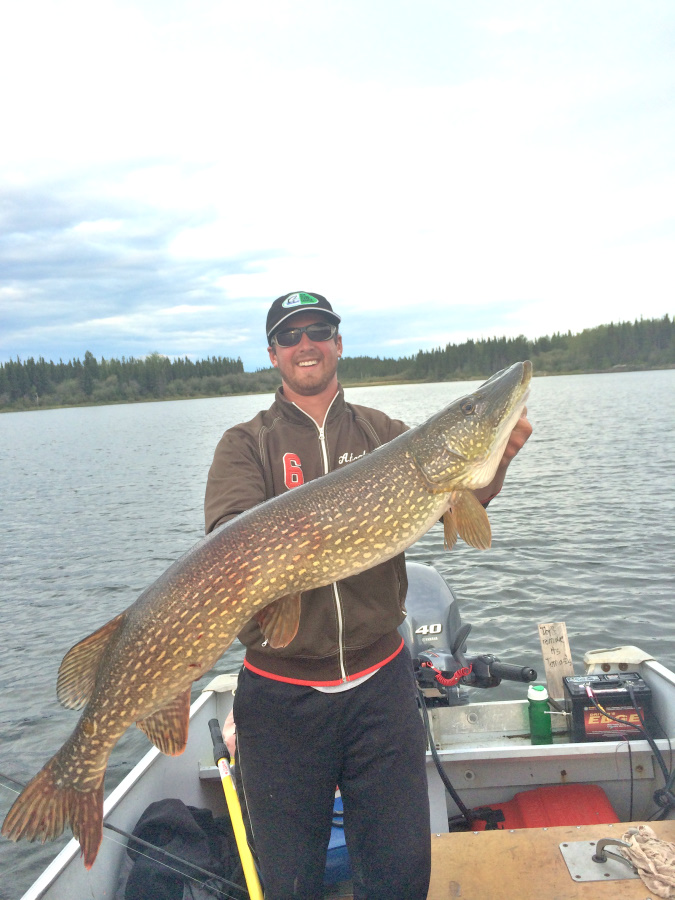
In 2019 after he graduated he worked season at Elk Island Lodge. This past year while guiding at the lodge he appeared on The New Fly Fisher television show. Click the link below to see the Episode from the lodge.
After the 2019 season he went traveling to Australia. In early 2020 we all know what happened and he ended up getting stuck out there. During his exile because of Covid he fell in love with Australia. He ended up working as a divemaster and snorkel guide on the Great Barrier Reef. On his days off he would fish and dive, enjoying species like the coral trout.
Follow Tomasz at:
