


/
RSS Feed
Welcome to The Complete Angler, your source of information on the outdoor industry in Central Canada.
With over 35 years in the field, host Don Lamont covers topics and issues with industry leaders and influencers
to bring you up to speed on what’s happening in the outdoor world.
And now, here is your host, Don Lamont.
Our guest on today’s show lives in the heart of musky country, northwestern Ontario.
Glenn and his wife, Kyla, reside in Vermilion Bay with their three daughters.
Kyla manages the famous Bobby’s Sports Shop there, and together they operate 54 or bust guide service.
A legal musky in this part of the world would measure 54 inches, thus the name.
Glenn and Kyla McDonald are regular contributors to Hooked Magazine, and you can find their work on our website.
Both have an intense passion for fishing, with musky on the top of the list.
They also recently added a new line of apparel named, of course, 54 or bust.
Hey, Glenn, welcome to The Complete Angler Podcast.
Great to see you.
Thanks for having me.
I’m looking forward to this.
Well, as I mentioned in the intro, Glenn has been writing for us for about three years now.
Is that correct, Glenn?
Yeah, I would believe it would be right around the three-year mark.
Yeah, we met at a show in Winnipeg, and I asked Glenn if he’d be interested in writing for Hooked,
and lo and behold, he’s been a great asset to the magazine, Glenn, I must mention.
Well, I appreciate that, and I do look forward to writing,
and I think being in northwestern Ontario where we are,
we bring a unique approach to the magazine, and then again, being in the musky world where I primarily live,
I think that’s another unique angle for the magazine that maybe some of the readers,
even if they don’t fish for muskies, it’s always cool to see big musky pictures.
Everybody gets a kick out of that kind of stuff.
Well, they sure do, and they’re not popular in this part of the world because we just don’t have them.
So northwestern Ontario is blessed with some of the best musky water in the world,
and your last article in Hooked was about the tiger musky.
Talk about that a little bit, how unique that fish is.
Well, that is very unique, and I think as the article said, we call it the unicorn of the e-socks world,
which it really is, and for a lot of people that fish for muskies, it’s one of those bucket list fish.
Everybody wants to catch a tiger musky, and we’re very fortunate in northwestern Ontario,
we have a high percentage of lakes that have both northern pike and native musky populations,
and because of our location, we get a lot of years where their spawning times and areas will overlap,
which leads to the tiger, and for us, we probably catch, in my boat, probably 25 to 30 percent of our muskies
are tiger muskies on any given year, so we’re real fortunate that way,
and I know a lot of people come up to our area specifically with the hope of catching a tiger musky,
so it is a really unique fish.
Well, let’s back up a little bit. Glenn, tell me how you got into fishing, first of all.
Well, I think like anybody that grew up in northwestern Ontario, you learn to ride a bicycle,
and you learn to go fishing with your dad or your family. I don’t even really remember when I started
fishing. I just know that that was a big pastime for my family. We always had a boat. We have a
family cabin on Blue Lake, which is a popular recreation lake, and we were just always fishing and just
always enjoyed being outside. It was simpler times back then when I was a kid. You made your own fun.
If you had a fishing rod and a couple twister tails, you were good for a day, and we enjoyed it.
Yeah, I can relate to that. Pretty much the same story on my end. How did this translate over…
We’re going to talk about pike fishing today, but I wanted to ask you, how did you become
obsessed with musky?
That’s probably a long answer, but I’ll give the short version. I don’t think anybody specifically
goes looking to get obsessed with musky. It’s one of those things that I think when you catch one or
two, and you see and you feel what they can do, that’s where that passion grows. It’s so unique in the
fishing world, but for me, I don’t remember my first musky. It was probably an incidental catch with my
dad. Dad probably flipped it off the outside of the boat, just kind of broke the jig head or whatever
the case was, a lot of us in Northwestern Ontario. But as I got a little bit older, and I lived on
Indian Lake Chain for a number of years, and the people that lived beside me, they rented out their
cabin to some Americans. Well, one group come up one year, and they were diehard musky guys, and they
asked if I could show them around the lake, basically guide them, but I didn’t really know much about
musky, so I took them to what I thought were the good spots. We caught some fish, and they got, they
let me use some stuff. I ended up catching the fish, so I was pretty hooked on it after that. So over time,
I probably spent like 5% of my summers actually casting for them. Fast forward a few years, I met my
wife Kyla. Her family is full-on just musky nuts, her dad and her two brothers, and from there, that would
have been about 12 years ago, that started the journey to where I am today, and I’m definitely
knee-deep in the musky world. Well, let’s talk about your wife, Kyla, because she is a hardcore
musky lady, and she also runs Bobby’s sport shop in Vermillion Bay. Yeah, that’s correct. So she,
her and her family have been in the fishing world their whole lives. Her family has worked at tourist
camps. Her mom was a cook at a tourist camp up in Ear Falls area for a number of years. I did some
guiding up there. Her brothers and her dad did some guiding. Kyla did some guiding. She was a teacher by
trade. And one summer, because the teachers got the summer off, she got an opportunity to work in
Bobby’s sport shop. And that’s just another passion of hers is the fishing. And it ties right into the
teaching. She loves to teach people about really any aspect that she can, you know, offer help on.
So she worked in the sport shop, and that turned into be there every time she had a day off. So that
worked good. And then as the owners went into selling, the new owner asked if she would stay on
and manage not only the sport shop, but the complete gas station convenience store. So she runs the whole
show there now. But through all that, her true passion there is Bobby’s sport shop.
Oh, that’s, that’s great. So if you’re in Vermillion Bay, you know where to find her.
Yeah, she’s there pretty much every day, nine to five. And if she’s not out front, she’s probably
got her head into the computer and the bookwork in the back. And I know she doesn’t always like that
part of it. Okay, well, let’s, let’s transfer over to the fishing part of it. Springs coming up. We’re
going to get rid of some ice pretty early this year. When do you think it might go? Glenn?
In the Dryden area, there’s been guys in the boats already. I know down in Rainy River, guys have
been walleye fishing on the river. One of my buddies was out at Bear Narrows on Eagle Lake, which is a
popular walleye spot. And because of the current, it’s already open. But beyond that, I think we’re
looking at probably the latter half of April, we’re going to be open for sure. So that’s going to allow
people that want to get out early a pretty good jump on the season. Explain the rules in Northwestern
Ontario about what’s open and what isn’t. Okay, so right now, walleye will be open until I believe
it’s the 15th of April. And that’s generally for ice fishing season. And then it closes until the
third Saturday in May. So even if we have ice out, you still can’t fish for walleye, but northern pike
and bass are open. So that’s, those would be the species that we would target. And I think that’s
what you want to kind of discuss a little bit today. Yeah, I got really excited to prepping for
this show, Glenn, because I thought back of all the early spring adventures I have. And on the
Hooked website, you could just do a search for pike and you’ll find all these articles on spring pike
and from a variety of different authors. And it’s, it’s really interesting to see all the different
opinions of where to find spring pike. So if, if you were going to go out as soon as the ice is off,
what would, what would you do? What would be your strategy, Glenn?
Well, it’ll be twofold. So just to kind of back up a little bit, as we go out in the early spring
and we’re on a lake that does have a population of musky, we, as musky angler anglers, I have to be
very careful where I try to target fish because I don’t want to target musky. And as you’re targeting pike,
as you probably well know, it’s that musky and pike overlap in the spawning areas, it can be real
tricky on, on targeting the correct species. So that being said, we’re probably going to go out and
target some of the lakes that don’t have a musky population. So on those lakes, I’m thinking smaller,
generally smaller lakes in our area. And as we go out early season like that, I’m going to be looking
to the weedy bays, the shallow weedy bays, typically with a sandy or bottom. And probably
about right now is when I would expect the big pike to be in. So as soon as ice out happens,
generally, the pike have already spawned in our area and are starting to move out or they’re right in
that transition period between the spawn and post spawn. So I’d be looking for those spawning
bays and try and, and try and target the bigger pike, either at the mouth of those bays or the
mouth of the creeks. For me, I don’t really have any interest trying to catch those smaller males that
are going to be back inside those weedy bays. I’m looking for the bigger ones on the, on the outside
edges. Well, that’s a, I hope the listeners take what you just said in, because that is a real key.
For me, the two key spots in early season pike are little deeper water and kind of on the front
of the bays, not the shallow back weedy stuff. Like that’s where the, like you said, the male piker
in, or if you’ve got a warm water inflow coming, um, that can really hold a lot of bait fish and that
can really attract some big pike. Uh, I know a couple of creeks that I fish in Lake of the Woods
where the water’s just pouring in warm water and those pike really start stacking in there and you
can have a lot of fun catching them. But I want to talk about this a little bit, because a lot of
people don’t understand that sometimes in the spring, the pike can be really scattered depending on,
you know, weather conditions, right. They can be scattered. They can be suspended,
but they can be a little difficult to find. I mean, they’re not always in, you know,
easy to identify spots. Do you find that? I would say that that is true. I just think that’s a bit
of a misnomer for people that fish for pike in general. People think that you can go into those
back ends of those bays and just catch pike, but you’re always catching those little quote unquote
hammer handle pike, people that target big pipe, they realize that that’s not where big pike are.
And, and in the early season, those big pike are always moving in and out of those spawning areas.
And I think big pike, much like big muskies, they realize where the dangers are and where they’re
vulnerable. And they try to keep out into those deeper edges. So I totally agree with you. I think
they can be a little bit harder to find, but I think if your strategy is stay out,
out in front of those spawning areas or those spawning creeks or find those key current areas,
like you’re talking about with the creeks, like we have the one lake Canyon Lake where the water flows
into it from Indian Lake chain. That’s always a popular spot in the spring. And unfortunately,
there’s musky there as well. So there’s going to be musky pike and walleye spawning in those,
or pre-spawning in those same areas. So you have to be a bit careful, but that warm water coming in,
that’s just a key area. And if you can find those deeper edges where that warmer water is mixing with
the cool water, I think those are key spots to target.
Further to that, I remember a show up in Northern Alberta, I was doing with Perry McCormick,
who was really an avid fly fisher. And we’re in this big back bay. Well, guess what? You know,
we were catching all the smaller males, the bigger females had long vacated. So we went out to the
main lake and there was this big, uh, this big flat on kind of the North end of the lake. And then we
saw all these dimples from, um, uh, there was an insect hatch going on. And then you could see a
little blurb with a whitefish or Cisco or whatever it was coming up and, you know, eating the mayflies.
So we put down the husky jerks down and we ended up catching big pike and big walleye. Just,
just from that simple thing, you know, they were out there feeding on,
that was their preferred forage in that lake. So they were going to be there, right?
Well, I think that holds true everywhere. You find where they’re going to feed. And when it doesn’t
matter what species it is, when they’re post-spawn, they’re going to take a little bit of time
to recover. And then they’re going to feed and pike, especially big pike, like big musky,
when they’re done spawning, they’re going to go out and they’re going to feed on the most rich
food source that they can. And in a lot of cases, yeah, it’ll be that Cisco whitefish sucker type of
forage. Okay. So, uh, you’ve done your homework. You figured out where some of the fish are now,
Glenn, how are you going to catch them? Well, for us, we’re going to probably approach it
with a musky mindset only because I think for us, it’s twofold. We’re going to be out there trying to
get ourselves prepped up for the musky season. And we, if we’re fishing a lake a little bit later
after ice out and we’re fishing for pike and or bass, because I think that’s another subject I’d like
to touch on because it ties right into my musky fishing. But if we’re out targeting pike and I
want to target some bigger pike and we’re casting those deeper edges, I’m going to use probably small
rubber. So many Medusas, maybe a Lake X toad, uh, Bondi Royal Orba stuff that I can count down and I can
rip pull. And I know that’s not really, uh, uh, Northern pike tactic, but from our musky world,
that allows me to get down into those slightly deeper areas where, like you said, on the flats,
where there might be pike out in that 20 foot area, we can get those baits down 10 or 12 feet,
rip them back in, or we’re going to use spinner baits and cast those deeper edges of, of whatever
emergent weeds we can find or from historical data where we know, you know, known weed edges might be.
Yeah, no, that’s, that’s a great point. And further to that, I even with, with the soft plastic,
whether it, uh, you know, be a boot tail or whatever, um, we like to let them sink, especially
if the pike are inactive and then just twitch them, you know, rip it a little bit up off the bottom,
then let it sit back down and rip it a bit off the bottom, let it sit back down.
And I’ve had some tremendous success doing it that way.
Yeah, I would totally agree again, because we’re not primarily pike fishermen or bass fishermen.
We’re using a bit of a modified approach. And if we’re on a lake where we know there’s muskies,
we can use that is, uh, almost like a pre-season scouting. So if we’re targeting pike and we start,
and we know that muskies are going to spawn a little bit later than pike. So if, if the big pike
have moved out of those back bays, there’s a good chance that the big muskies are pre-staging to go
into spawn. So we may, may enter intercept some of those big muskies. And for us, that’s a good key
that we know, okay, where are these big fish going to be for the opening of musky season? So we’re always
looking at it, coming at it from a couple of different angles. We’re always using pike fishing
early in the season as, as you know, gear up, figure out what it is we’re going to do. And we’re also
looking to see where we might see some musky activity.
Nice to have that luxury Glenn.
Well, it is hard to take the musky angler out of, out of us because that’s, that’s where we live.
So we use that pre-season and to take it one step further, if we’re at the end of May, beginning of
June, which in Northwestern Ontario is pretty close to the bass spawning time. We love to get out and do
some small mouth bass fishing. Again, we use it as almost a pre-season scouting for musky because a
lot of times where those bass are spawning, there’s going to be muskies around. And again,
whether where there’s bass spawning, the muskies are going to be close because that bass can be a
food source for a musky as they start to congregate to, to spawn. So we’re always coming at it with two
different approaches. Yeah, that’s a, that’s a great, when does musky season open?
Third Saturday in June. So for us up in our area in Northwestern Ontario, it’s a long wait. We look
through the social media and the guys down in Wisconsin and Illinois are already fishing and
Southern Ontario opens almost a month before us. So it can be a long wait for us up here. So we,
we try to do everything we can to be as, as prepped up and as ready as we can. And that’s the beauty of
having the ability to go pike fishing and bass fishing early.
Glenn, let’s talk about your guide service. When did, when did you start guiding and how can people
find out and book you?
Well, I started not long after I met Kyla and we’d started doing some guiding up on long legged
lake and Northwestern Ontario up by ear falls. That’s kind of where I got the passion for the guiding
side of, of musky. And I guided a little bit of walleye and pike and, and other species, but
excuse me, as I got more into musky fishing, I’m, I just, I love the approach of the
teaching somebody how to hunt for muskies. I think a lot of people that are hunters and musky anglers,
they compare the two because you’re truly hunting for muskies on the water. Anybody that’s done it
knows that. So I like taking people out. And if I can get somebody on their first musky,
that’s just a feeling that you see it in somebody’s face when they finally hoist the musky out of the
net. So that’s where the passion for the guiding came from. And as Kyla started doing more at Bobby’s
sports shop and I started to get a little bit busier in the musky world, I started guiding for
a couple of the local camps and I was just doing just part-time because I have a full-time job in
the logging industry. So that the guiding was just a nice little kind of a side hustle. And three,
three years ago, I got to the point where it was almost too busy. I didn’t have any family time or any
private time to myself. So it’s finding that balance in it. And right now I try to limit myself to about
20 days of guiding a year. So I let people know that my dates are going to be limited,
but I will try and and fit in as many people as I can. So it’s a balancing act between family work
and guiding. Talk a little bit about the 54 bust. I understand you have a new line of clothing.
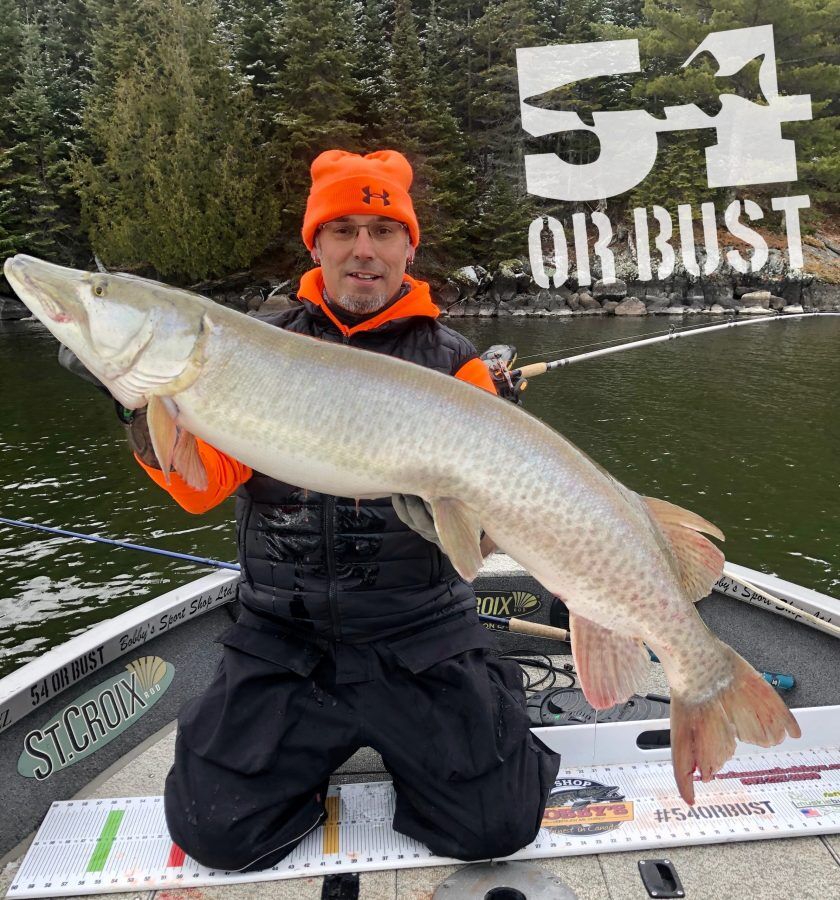
Yeah. So I, my guide service is called 54 bust and the 54 comes from the legal musky size and most of the major lakes in Ontario, it has to be 54 inches or larger to keep it, which nobody keeps a musky anymore. It’s throughout the musky world. It’s strictly catch and release. And with the replicas that you can get made now, there’s absolutely no reason to keep a fish, but the legal limit is 54. So I branded myself as 54 bust. And it’s a little, I guess, a play on words because as musky guys were always after that, that legal fish and in Northwestern Ontario, that’s a pretty tough benchmark to hit. I haven’t hit it personally. So we started 54 bust pretty well. All my socials are branded as 54 bust. So it’s real easy to find me. I got a YouTube page, 54 bust. And this year I’m going to be super active on YouTube. So I would tell anybody just go on YouTube and search 54 bust and you’ll find me and I have tons of lake specific info and tips and tricks all through the summer. I plan to be pretty much on the water four to five days a week with on the water tips. And it won’t be just musky as we’re out for pike and bass in the early season. We’ll include that.
But back to the clothing. I tried to get a cool logo going for probably two years now and we just never felt that I had something that I was real confident with.
And this past fall, I was able to come up with a logo and I did make it myself and I designed it
myself. So I’m pretty proud of it. And the five and the four above the four bust has in the negative
space. It’s the cutout of a musky. And I will include the picture for the cover of this podcast
with my watermark. So the listeners can kind of see that as well. And if anybody searches through
my socials, it won’t take you long to find a link to either order some of it or at least check out some
of the stuff we have right now. We’ve been selling hats, toques, beanies, and I have a line of hoodies
and t-shirts coming and we’ll be doing some more as the summer kind of comes on to us.
Well, Glenn, congrats on all the success you’ve been having and your great work and your great writing.
Thanks again for your contributions to Hooked Magazine. And boy, I look forward to one day,
hopefully getting in the boat with you. I know you’re a really busy guy, but hopefully all these
restrictions loosen up and it’s a great fishing season in Northwestern Ontario. So Glenn, thanks
very much for coming on the show. I appreciate it very much. And I hope all the listeners get something
informative from this and all your podcasts because I think you’re doing a very good job there. And
I look forward to listening to them as you post them as well. Glenn, we’re going to have you back
on just before the muskie season to get everybody primed up for that. You okay with that?
Absolutely. And I’ll tell the listeners to look for the next Hooked Magazine because the next article is
going to be a continuation of our discussion today. It’ll be kind of the transition between pike bass
and then into muskie season. So I think the listeners and the readers will get something
interesting and informative out of that too. All right, Glenn. Thanks so much. Take care.
Thanks, Don. Have a good day. Thanks for tuning in. Visit hookedmagazine.com
to subscribe to The Complete Angler and never miss an episode.
With over 35 years in the field, host Don Lamont covers topics and issues with industry leaders and influencers
to bring you up to speed on what’s happening in the outdoor world.
And now, here is your host, Don Lamont.
Our guest on today’s show lives in the heart of musky country, northwestern Ontario.
Glenn and his wife, Kyla, reside in Vermilion Bay with their three daughters.
Kyla manages the famous Bobby’s Sports Shop there, and together they operate 54 or bust guide service.
A legal musky in this part of the world would measure 54 inches, thus the name.
Glenn and Kyla McDonald are regular contributors to Hooked Magazine, and you can find their work on our website.
Both have an intense passion for fishing, with musky on the top of the list.
They also recently added a new line of apparel named, of course, 54 or bust.
Hey, Glenn, welcome to The Complete Angler Podcast.
Great to see you.
Thanks for having me.
I’m looking forward to this.
Well, as I mentioned in the intro, Glenn has been writing for us for about three years now.
Is that correct, Glenn?
Yeah, I would believe it would be right around the three-year mark.
Yeah, we met at a show in Winnipeg, and I asked Glenn if he’d be interested in writing for Hooked,
and lo and behold, he’s been a great asset to the magazine, Glenn, I must mention.
Well, I appreciate that, and I do look forward to writing,
and I think being in northwestern Ontario where we are,
we bring a unique approach to the magazine, and then again, being in the musky world where I primarily live,
I think that’s another unique angle for the magazine that maybe some of the readers,
even if they don’t fish for muskies, it’s always cool to see big musky pictures.
Everybody gets a kick out of that kind of stuff.
Well, they sure do, and they’re not popular in this part of the world because we just don’t have them.
So northwestern Ontario is blessed with some of the best musky water in the world,
and your last article in Hooked was about the tiger musky.
Talk about that a little bit, how unique that fish is.
Well, that is very unique, and I think as the article said, we call it the unicorn of the e-socks world,
which it really is, and for a lot of people that fish for muskies, it’s one of those bucket list fish.
Everybody wants to catch a tiger musky, and we’re very fortunate in northwestern Ontario,
we have a high percentage of lakes that have both northern pike and native musky populations,
and because of our location, we get a lot of years where their spawning times and areas will overlap,
which leads to the tiger, and for us, we probably catch, in my boat, probably 25 to 30 percent of our muskies
are tiger muskies on any given year, so we’re real fortunate that way,
and I know a lot of people come up to our area specifically with the hope of catching a tiger musky,
so it is a really unique fish.
Well, let’s back up a little bit. Glenn, tell me how you got into fishing, first of all.
Well, I think like anybody that grew up in northwestern Ontario, you learn to ride a bicycle,
and you learn to go fishing with your dad or your family. I don’t even really remember when I started
fishing. I just know that that was a big pastime for my family. We always had a boat. We have a
family cabin on Blue Lake, which is a popular recreation lake, and we were just always fishing and just
always enjoyed being outside. It was simpler times back then when I was a kid. You made your own fun.
If you had a fishing rod and a couple twister tails, you were good for a day, and we enjoyed it.
Yeah, I can relate to that. Pretty much the same story on my end. How did this translate over…
We’re going to talk about pike fishing today, but I wanted to ask you, how did you become
obsessed with musky?
That’s probably a long answer, but I’ll give the short version. I don’t think anybody specifically
goes looking to get obsessed with musky. It’s one of those things that I think when you catch one or
two, and you see and you feel what they can do, that’s where that passion grows. It’s so unique in the
fishing world, but for me, I don’t remember my first musky. It was probably an incidental catch with my
dad. Dad probably flipped it off the outside of the boat, just kind of broke the jig head or whatever
the case was, a lot of us in Northwestern Ontario. But as I got a little bit older, and I lived on
Indian Lake Chain for a number of years, and the people that lived beside me, they rented out their
cabin to some Americans. Well, one group come up one year, and they were diehard musky guys, and they
asked if I could show them around the lake, basically guide them, but I didn’t really know much about
musky, so I took them to what I thought were the good spots. We caught some fish, and they got, they
let me use some stuff. I ended up catching the fish, so I was pretty hooked on it after that. So over time,
I probably spent like 5% of my summers actually casting for them. Fast forward a few years, I met my
wife Kyla. Her family is full-on just musky nuts, her dad and her two brothers, and from there, that would
have been about 12 years ago, that started the journey to where I am today, and I’m definitely
knee-deep in the musky world. Well, let’s talk about your wife, Kyla, because she is a hardcore
musky lady, and she also runs Bobby’s sport shop in Vermillion Bay. Yeah, that’s correct. So she,
her and her family have been in the fishing world their whole lives. Her family has worked at tourist
camps. Her mom was a cook at a tourist camp up in Ear Falls area for a number of years. I did some
guiding up there. Her brothers and her dad did some guiding. Kyla did some guiding. She was a teacher by
trade. And one summer, because the teachers got the summer off, she got an opportunity to work in
Bobby’s sport shop. And that’s just another passion of hers is the fishing. And it ties right into the
teaching. She loves to teach people about really any aspect that she can, you know, offer help on.
So she worked in the sport shop, and that turned into be there every time she had a day off. So that
worked good. And then as the owners went into selling, the new owner asked if she would stay on
and manage not only the sport shop, but the complete gas station convenience store. So she runs the whole
show there now. But through all that, her true passion there is Bobby’s sport shop.
Oh, that’s, that’s great. So if you’re in Vermillion Bay, you know where to find her.
Yeah, she’s there pretty much every day, nine to five. And if she’s not out front, she’s probably
got her head into the computer and the bookwork in the back. And I know she doesn’t always like that
part of it. Okay, well, let’s, let’s transfer over to the fishing part of it. Springs coming up. We’re
going to get rid of some ice pretty early this year. When do you think it might go? Glenn?
In the Dryden area, there’s been guys in the boats already. I know down in Rainy River, guys have
been walleye fishing on the river. One of my buddies was out at Bear Narrows on Eagle Lake, which is a
popular walleye spot. And because of the current, it’s already open. But beyond that, I think we’re
looking at probably the latter half of April, we’re going to be open for sure. So that’s going to allow
people that want to get out early a pretty good jump on the season. Explain the rules in Northwestern
Ontario about what’s open and what isn’t. Okay, so right now, walleye will be open until I believe
it’s the 15th of April. And that’s generally for ice fishing season. And then it closes until the
third Saturday in May. So even if we have ice out, you still can’t fish for walleye, but northern pike
and bass are open. So that’s, those would be the species that we would target. And I think that’s
what you want to kind of discuss a little bit today. Yeah, I got really excited to prepping for
this show, Glenn, because I thought back of all the early spring adventures I have. And on the
Hooked website, you could just do a search for pike and you’ll find all these articles on spring pike
and from a variety of different authors. And it’s, it’s really interesting to see all the different
opinions of where to find spring pike. So if, if you were going to go out as soon as the ice is off,
what would, what would you do? What would be your strategy, Glenn?
Well, it’ll be twofold. So just to kind of back up a little bit, as we go out in the early spring
and we’re on a lake that does have a population of musky, we, as musky angler anglers, I have to be
very careful where I try to target fish because I don’t want to target musky. And as you’re targeting pike,
as you probably well know, it’s that musky and pike overlap in the spawning areas, it can be real
tricky on, on targeting the correct species. So that being said, we’re probably going to go out and
target some of the lakes that don’t have a musky population. So on those lakes, I’m thinking smaller,
generally smaller lakes in our area. And as we go out early season like that, I’m going to be looking
to the weedy bays, the shallow weedy bays, typically with a sandy or bottom. And probably
about right now is when I would expect the big pike to be in. So as soon as ice out happens,
generally, the pike have already spawned in our area and are starting to move out or they’re right in
that transition period between the spawn and post spawn. So I’d be looking for those spawning
bays and try and, and try and target the bigger pike, either at the mouth of those bays or the
mouth of the creeks. For me, I don’t really have any interest trying to catch those smaller males that
are going to be back inside those weedy bays. I’m looking for the bigger ones on the, on the outside
edges. Well, that’s a, I hope the listeners take what you just said in, because that is a real key.
For me, the two key spots in early season pike are little deeper water and kind of on the front
of the bays, not the shallow back weedy stuff. Like that’s where the, like you said, the male piker
in, or if you’ve got a warm water inflow coming, um, that can really hold a lot of bait fish and that
can really attract some big pike. Uh, I know a couple of creeks that I fish in Lake of the Woods
where the water’s just pouring in warm water and those pike really start stacking in there and you
can have a lot of fun catching them. But I want to talk about this a little bit, because a lot of
people don’t understand that sometimes in the spring, the pike can be really scattered depending on,
you know, weather conditions, right. They can be scattered. They can be suspended,
but they can be a little difficult to find. I mean, they’re not always in, you know,
easy to identify spots. Do you find that? I would say that that is true. I just think that’s a bit
of a misnomer for people that fish for pike in general. People think that you can go into those
back ends of those bays and just catch pike, but you’re always catching those little quote unquote
hammer handle pike, people that target big pipe, they realize that that’s not where big pike are.
And, and in the early season, those big pike are always moving in and out of those spawning areas.
And I think big pike, much like big muskies, they realize where the dangers are and where they’re
vulnerable. And they try to keep out into those deeper edges. So I totally agree with you. I think
they can be a little bit harder to find, but I think if your strategy is stay out,
out in front of those spawning areas or those spawning creeks or find those key current areas,
like you’re talking about with the creeks, like we have the one lake Canyon Lake where the water flows
into it from Indian Lake chain. That’s always a popular spot in the spring. And unfortunately,
there’s musky there as well. So there’s going to be musky pike and walleye spawning in those,
or pre-spawning in those same areas. So you have to be a bit careful, but that warm water coming in,
that’s just a key area. And if you can find those deeper edges where that warmer water is mixing with
the cool water, I think those are key spots to target.
Further to that, I remember a show up in Northern Alberta, I was doing with Perry McCormick,
who was really an avid fly fisher. And we’re in this big back bay. Well, guess what? You know,
we were catching all the smaller males, the bigger females had long vacated. So we went out to the
main lake and there was this big, uh, this big flat on kind of the North end of the lake. And then we
saw all these dimples from, um, uh, there was an insect hatch going on. And then you could see a
little blurb with a whitefish or Cisco or whatever it was coming up and, you know, eating the mayflies.
So we put down the husky jerks down and we ended up catching big pike and big walleye. Just,
just from that simple thing, you know, they were out there feeding on,
that was their preferred forage in that lake. So they were going to be there, right?
Well, I think that holds true everywhere. You find where they’re going to feed. And when it doesn’t
matter what species it is, when they’re post-spawn, they’re going to take a little bit of time
to recover. And then they’re going to feed and pike, especially big pike, like big musky,
when they’re done spawning, they’re going to go out and they’re going to feed on the most rich
food source that they can. And in a lot of cases, yeah, it’ll be that Cisco whitefish sucker type of
forage. Okay. So, uh, you’ve done your homework. You figured out where some of the fish are now,
Glenn, how are you going to catch them? Well, for us, we’re going to probably approach it
with a musky mindset only because I think for us, it’s twofold. We’re going to be out there trying to
get ourselves prepped up for the musky season. And we, if we’re fishing a lake a little bit later
after ice out and we’re fishing for pike and or bass, because I think that’s another subject I’d like
to touch on because it ties right into my musky fishing. But if we’re out targeting pike and I
want to target some bigger pike and we’re casting those deeper edges, I’m going to use probably small
rubber. So many Medusas, maybe a Lake X toad, uh, Bondi Royal Orba stuff that I can count down and I can
rip pull. And I know that’s not really, uh, uh, Northern pike tactic, but from our musky world,
that allows me to get down into those slightly deeper areas where, like you said, on the flats,
where there might be pike out in that 20 foot area, we can get those baits down 10 or 12 feet,
rip them back in, or we’re going to use spinner baits and cast those deeper edges of, of whatever
emergent weeds we can find or from historical data where we know, you know, known weed edges might be.
Yeah, no, that’s, that’s a great point. And further to that, I even with, with the soft plastic,
whether it, uh, you know, be a boot tail or whatever, um, we like to let them sink, especially
if the pike are inactive and then just twitch them, you know, rip it a little bit up off the bottom,
then let it sit back down and rip it a bit off the bottom, let it sit back down.
And I’ve had some tremendous success doing it that way.
Yeah, I would totally agree again, because we’re not primarily pike fishermen or bass fishermen.
We’re using a bit of a modified approach. And if we’re on a lake where we know there’s muskies,
we can use that is, uh, almost like a pre-season scouting. So if we’re targeting pike and we start,
and we know that muskies are going to spawn a little bit later than pike. So if, if the big pike
have moved out of those back bays, there’s a good chance that the big muskies are pre-staging to go
into spawn. So we may, may enter intercept some of those big muskies. And for us, that’s a good key
that we know, okay, where are these big fish going to be for the opening of musky season? So we’re always
looking at it, coming at it from a couple of different angles. We’re always using pike fishing
early in the season as, as you know, gear up, figure out what it is we’re going to do. And we’re also
looking to see where we might see some musky activity.
Nice to have that luxury Glenn.
Well, it is hard to take the musky angler out of, out of us because that’s, that’s where we live.
So we use that pre-season and to take it one step further, if we’re at the end of May, beginning of
June, which in Northwestern Ontario is pretty close to the bass spawning time. We love to get out and do
some small mouth bass fishing. Again, we use it as almost a pre-season scouting for musky because a
lot of times where those bass are spawning, there’s going to be muskies around. And again,
whether where there’s bass spawning, the muskies are going to be close because that bass can be a
food source for a musky as they start to congregate to, to spawn. So we’re always coming at it with two
different approaches. Yeah, that’s a, that’s a great, when does musky season open?
Third Saturday in June. So for us up in our area in Northwestern Ontario, it’s a long wait. We look
through the social media and the guys down in Wisconsin and Illinois are already fishing and
Southern Ontario opens almost a month before us. So it can be a long wait for us up here. So we,
we try to do everything we can to be as, as prepped up and as ready as we can. And that’s the beauty of
having the ability to go pike fishing and bass fishing early.
Glenn, let’s talk about your guide service. When did, when did you start guiding and how can people
find out and book you?
Well, I started not long after I met Kyla and we’d started doing some guiding up on long legged
lake and Northwestern Ontario up by ear falls. That’s kind of where I got the passion for the guiding
side of, of musky. And I guided a little bit of walleye and pike and, and other species, but
excuse me, as I got more into musky fishing, I’m, I just, I love the approach of the
teaching somebody how to hunt for muskies. I think a lot of people that are hunters and musky anglers,
they compare the two because you’re truly hunting for muskies on the water. Anybody that’s done it
knows that. So I like taking people out. And if I can get somebody on their first musky,
that’s just a feeling that you see it in somebody’s face when they finally hoist the musky out of the
net. So that’s where the passion for the guiding came from. And as Kyla started doing more at Bobby’s
sports shop and I started to get a little bit busier in the musky world, I started guiding for
a couple of the local camps and I was just doing just part-time because I have a full-time job in
the logging industry. So that the guiding was just a nice little kind of a side hustle. And three,
three years ago, I got to the point where it was almost too busy. I didn’t have any family time or any
private time to myself. So it’s finding that balance in it. And right now I try to limit myself to about
20 days of guiding a year. So I let people know that my dates are going to be limited,
but I will try and and fit in as many people as I can. So it’s a balancing act between family work
and guiding. Talk a little bit about the 54 bust. I understand you have a new line of clothing.
Yeah. So I, my guide service is called 54 bust and the 54 comes from the legal musky size and most of the major lakes in Ontario, it has to be 54 inches or larger to keep it, which nobody keeps a musky anymore. It’s throughout the musky world. It’s strictly catch and release. And with the replicas that you can get made now, there’s absolutely no reason to keep a fish, but the legal limit is 54. So I branded myself as 54 bust. And it’s a little, I guess, a play on words because as musky guys were always after that, that legal fish and in Northwestern Ontario, that’s a pretty tough benchmark to hit. I haven’t hit it personally. So we started 54 bust pretty well. All my socials are branded as 54 bust. So it’s real easy to find me. I got a YouTube page, 54 bust. And this year I’m going to be super active on YouTube. So I would tell anybody just go on YouTube and search 54 bust and you’ll find me and I have tons of lake specific info and tips and tricks all through the summer. I plan to be pretty much on the water four to five days a week with on the water tips. And it won’t be just musky as we’re out for pike and bass in the early season. We’ll include that.
But back to the clothing. I tried to get a cool logo going for probably two years now and we just never felt that I had something that I was real confident with.
And this past fall, I was able to come up with a logo and I did make it myself and I designed it
myself. So I’m pretty proud of it. And the five and the four above the four bust has in the negative
space. It’s the cutout of a musky. And I will include the picture for the cover of this podcast
with my watermark. So the listeners can kind of see that as well. And if anybody searches through
my socials, it won’t take you long to find a link to either order some of it or at least check out some
of the stuff we have right now. We’ve been selling hats, toques, beanies, and I have a line of hoodies
and t-shirts coming and we’ll be doing some more as the summer kind of comes on to us.
Well, Glenn, congrats on all the success you’ve been having and your great work and your great writing.
Thanks again for your contributions to Hooked Magazine. And boy, I look forward to one day,
hopefully getting in the boat with you. I know you’re a really busy guy, but hopefully all these
restrictions loosen up and it’s a great fishing season in Northwestern Ontario. So Glenn, thanks
very much for coming on the show. I appreciate it very much. And I hope all the listeners get something
informative from this and all your podcasts because I think you’re doing a very good job there. And
I look forward to listening to them as you post them as well. Glenn, we’re going to have you back
on just before the muskie season to get everybody primed up for that. You okay with that?
Absolutely. And I’ll tell the listeners to look for the next Hooked Magazine because the next article is
going to be a continuation of our discussion today. It’ll be kind of the transition between pike bass
and then into muskie season. So I think the listeners and the readers will get something
interesting and informative out of that too. All right, Glenn. Thanks so much. Take care.
Thanks, Don. Have a good day. Thanks for tuning in. Visit hookedmagazine.com
to subscribe to The Complete Angler and never miss an episode.
Our guest on today’s show is one of the top musky anglers in Northwestern Ontario. He and his wife Kyla, reside in Vermillion Bay with their three daughters. Kyla manages the famous Bobby’s Sport Shop there, and together they operate 54 or Bust Guide Service. Both have an intense passion for fishing, with musky on the top of the list.
Glenn and Kyla McDonald are regular contributors to Hooked Magazine and you can find their work on our website.