


Walleye Fishing with Bass Baits
If you’ve spent enough time on the water chasing different species, you eventually realize fish don’t always follow the rules. I’ve learned this the fun way—hooking a lot of walleyes on baits manufactured and marketed primarily for bass fishing. While I spend plenty of time focused on bass, one of my favourite detours is targeting walleye with the same baits I’d throw for smallmouth bass.

The jerk bait has been around the longest of the crossover bass/walleye baits I’m going to go cover. If you’ve spent any time behind the wheel of a Jerkbait in a shield lake in Canada, you’ll know it catches everything. The minnow shaped profile and eratic action is perfect for chasing walleye in 6-15 feet of water. For both bass and walleye, I reach for the Rapala Mavrik 110 anything under 12’ deep, and the Mavrik 110 deep for anything over 12’. The key to the jerk bait is reeling down a little bit to get it started and figuring out what cadence is working on each individual day. One thing about jerk bait walleye that I often see misunderstood is that it is for large and aggressive walleye at peak feeding periods, when the opposite is true. The jerk bait shines during tough bites and periods of inactivity. The eratic action triggers fish with a reaction bite, as opposed to a finesse or live bait approach. The next time you’re on a pod of walleye that you can’t even catch with a leech, try out the jerk bait, you may be surprised at the results.

The Ned rig may be the most talked about bass setup that’s been putting walleye in the boat the last few years. It probably has the most lacklustre profile in all of fishing, but it is often too much for a walleye to pass up. The Ned rig is always my first cast when targeting walleye across central Canada throughout the open water season. Like anything, there are some tricks to dial it in for maximum success. The best trick I know is to upsize your jighead. If you typically pitch an 1/8 oz jig in 8 feet of water for walleye, try doubling the weight to 1/4 for your Ned rig. This allows you to shake the bait aggressively without losing bottom contact; this is the primary key to catching walleye on the Ned. Another trick often looked over is to use a football style jig head vs a traditional ned head. I use the BT Fishing Crusher Jig which we specifically designed for Ned rigging. The shape of the head allows my Ned BLT plastic to maintain it’s upright position, while the wide profile of the football jig prevents it from falling on it’s side, maximizing each cast.
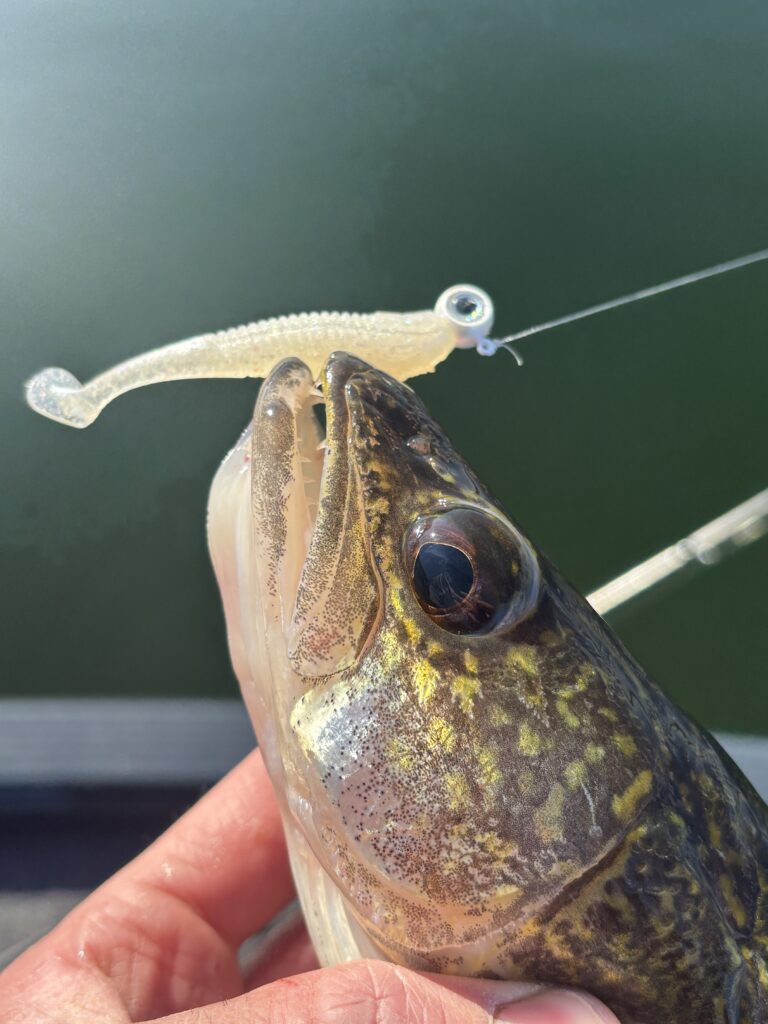
The swim bait is probably the most versatile crossover bait across the walleye belt. Anywhere from the Rainy River to the Mississippi River, to the Whiteshell region, swim baiting for walleyes is usually a safe bet. Unlike the Ned, a paddle tail swim bait can mean anything from a tiny 2.75” Crush City Suspect to a 1 lb paddle tail the size of a baby’s arm, and they both catch walleye. Baitfish size is the biggest consideration when you’re swim baiting walleye. As I write this I am fresh off a guide trip on Lake of the Woods in Late May. The shallows are flooded with 2.5”-3” perch and shiners, so naturally the 2.5”-3” is by far the best pick. Later in the year, as the biggest walleye in the lake move out to deep water hunting ciscos, I won’t be afraid to pull out the bait caster and throw a 1/2 oz 6” swim bait at giant solitary walleye. A straight reel technique is the most common, and can be taught to anyone who has every held a rod and reel. It’s very effective, but as your swim baiting game advances, don’t be afraid to throw some twitches and hard pauses into your retrieve; it all comes with time.
Give these a shot this season and you may feel less likely to stop at the bait store, or simply just expand to your walleye catching arsenal. Be safe out there, thanks for reading!
