

With over 35 years in the field, host Don Lamont covers topics and issues with industry leaders and influencers to bring you up to speed on what’s happening in the outdoor world.
And now, here is your host, Don Lamont.
On this edition of The Complete Angler podcast, we visit with our wandering angler, Dale Martens.
Since retiring from teaching, he has been visiting some of his bucket list fishing destinations.
These include Iceland, Bolivia, Northern Manitoba, and Europe.
You can find these stories on the pages of the Hooked website.
Hey, Dale, welcome to The Complete Angler podcast. Great to have you on.
Ah, thanks. I’m happy to be here.
Just so you know, I was a big fan of The Complete Angler when I was a kid.
Oh, nice to hear.
Now, you spent a lot of time going up Highway No. 10 with your dad.
Did you live in Winkler when you headed up No. 10?
No.
I was born in Winnipeg and went to school in Winnipeg.
So, that was our home base.
Ah, okay.
And went up Highway No. 10 like every year from age 9 to, I don’t know, 16 or 17.
And where did you go?
Ah, well, we started off, we just had a canoe.
We started off going into Riding Mountain.
And then, the next year, we went into the ducks.
And we went to the ducks for a couple years.
And then, for a couple years after that, we went a little further into the porcupines.
And around then, at the age of, I don’t know, 14 or 15, we got a boat.
And then, we started going all the way up to the grass river system, Gisquassum Lake.
And on the way, we’d always stop in the ducks and the porcupines to fish the Pine River, the Steep Rock River.
That Pine River is quite something, as well as the Steep Rock.
Now, you had some pretty fond memories of the Steep Rock, didn’t you?
Yeah.
I lived in Swan River for a couple years, just after I started teaching.
And I loved it there, just because of the Pine River and the Steep Rock River.
I spent a lot of time going up both those creeks.
Wasn’t into fly fishing back then?
But it’s just as much fun with a spinning rod.
It’s great.
I love it.
Yeah, a little spinner.
I’ve done both rivers, and they’re pretty spectacular.
And some sections are really rugged, as well.
You’ve got to be in decent shape to go in there.
Yeah, yeah, yeah, that’s true.
It can be a pretty tough slogging.
One guy who I hung around with a bit in Swan River, he would actually, in his younger days,
put a backpack on his back and start at Steep Rock Lake and go all the way down the Steep Rock River,
right to Highway 10.
Oh, wow.
Sleeping in the bush.
Yeah, he was hardcore.
Yeah, that’s ambitious.
Yeah, that’s pretty cool.
So you were a science teacher since retired, but still subbing?
Yeah, yeah.
Still sub a couple days a week if I’m around, exactly.
Well, you’ve got to pay for your travel addiction.
Exactly, yeah.
So have you been traveling all your life?
I suppose so.
If you include those road trips as a kid, going to university, to tell you the truth, going to university,
I took a bit of a break from fishing, but went on a lot of road trips, skiing to various places.
When I graduated from university and got a job, got married, we were always doing road trips somewhere out west.
And, yeah, eventually in the last few years, like since about 2007, my daughter was old enough to be on her own.
I started going even further, like extending a trip to Europe or wherever.
Yeah, it’d give you a little more flexibility, right?
Yeah, yeah, yeah.
So how long have you been writing for Hooked now?
Since fall of 21, I believe, right after Deb and I were in Iceland.
Okay.
And that was a hell of a trip, wasn’t it?
Oh, yeah.
Iceland is cool.
It’s a geologically tortured country, and it’s really beautiful to look at.
Everywhere you look, there’s some to see black lava fields, lush green vegetation on top of the black lava.
All kinds of rivers, like you can’t drive, I don’t know, 10 minutes without crossing a fishy-looking river.
And, of course, yeah, I spent the day fishing up there.
Yeah, I’m well acquainted with it.
My wife was born in Iceland, and her parents moved over here when she was young, and they actually moved back, and then back here again.
So she’s been back a few times with the kids, but unfortunately, I haven’t made it.
But everybody that goes, I think they say the same thing.
This really is a spectacular destination for many people.
They just don’t understand how rugged a country it really is.
Oh, yeah.
We went in September, slightly off-season, and at that latitude, I’m pretty sure September is more equivalent to our October.
And we were basically dealing with snow our whole last week there.
We wanted to hit one certain part of the island, and we absolutely could not go there.
The roads were closed because they were experiencing wind gusts of, oh, well over 100 kilometers an hour.
It might have even been close to 100 miles an hour.
It was some really severe weather.
And apparently, a real problem with rental cars there is you drive across certain sections of highway
where the road is really exposed, and if the wind gets high enough, it’ll pick up all the black sand from the surrounding area,
and it’ll basically sandblast your rental car and take the paint job right off it.
It’s a different world.
Yeah, it’s a rugged country.
All the bridges are, or a lot of the bridges are one lane instead of two because they have so many thermal events in the middle of the island that cause all this snow to melt.
The melting snow rushes down the river, takes out a bridge.
They have a lot of bridge washouts, and it’s cheaper to replace a one-lane bridge than a two-lane bridge.
Well, you’ve been to some pretty other wild places.
The latest story that’s coming out in the winter issue, which will be out here shortly, is your trip to the Baja.
And what surprised me, you went in the summertime.
That’s when the fishing is the best.
That’s when the dorado come in.
Wow.
How did you find out about that?
Yeah, for the longest time, probably since, oh, late 90s, early 2000s, one of the online forums I hang around on is the Dan Blanton Bowling Board.
And a lot of the guys there are from Southern California, so they’re just a hop, skip, and a jump north of Baja.
And the fishing in Baja is always a topic on that bulletin board, and it always came up around June, July every year.
You know, oh, you know, how’s the dorado bite in Loretto?
And you guys post about it, and you hear all these stories.
And, yeah, eventually I just had to try it for myself.
And I’m glad I did.
It was super fun.
Yeah, spectacular looking by the pictures you brought back.
Oh, yeah.
Yeah, the stark ocean, and all of a sudden, boom, this blue water with porpoises jumping through it.
Or better yet, a dorado at the end of your line, jumping.
Yeah, it’s a cool place.
Land of contrasts.
One of the most interesting stories that you wrote, for me at least, because I do a lot of travel with my wife in Europe,
was your experiences trying to get a fishing license and a guide in some of these European countries.
Oh, yeah, yeah.
Right, right, right.
Yeah, that’s the big challenge in fishing Europe in a lot of places, is tracking down the right license.
Because in Europe, in a lot of places, you need the government license, but you also have to get a license from whoever owns the particular water rights to wherever you want to fish.
And that can be a challenge.
I was actually fishing in Spain, and I started reading about hunting down licenses, and I just gave up.
I hired a guy to let them worry about it.
In Czechoslovakia, I managed to lock onto a taxi driver who played in a blues band.
So, he picked up English by learning the lyrics to all these blues songs, and he basically walked me right through the process of getting a license.
You know, here’s the office we’ve got to go to.
He marched me in there.
He explained my situation to who was running the office, and yeah, basically got me the license.
Wow.
Yeah, it’s another adventure.
And then there’s the fishing gear after that.
So, you just got back recently from Alaska, and that’s going to be your next story coming up in the special edition next year?
Oh, yeah, yeah, yeah.
So, what was that like?
It was amazing.
I’ve been to Alaska before.
Like, I’ve done the road trip thing way back in the 90s.
Traveled through quite a bit of the interior.
Did a lot of roadside fishing.
Caught a ton of pink salmon, which are fun to catch, but they’re not very big.
Like, a big pink is like 18, 19, 20 inches.
Did a cruise with my daughter, and that’s really cool.
Got to see the icebergs calving into the ocean.
Again, did a little bit of fishing.
Again, lots of pinks, you know, these little tiny things.
Got one big bonus king of about 15 or 20 pounds.
But I’d never really been to remote interior Alaska, and that’s where this trip was.
You flew into the mountains in the middle of the tundra, basically hopped in a raft,
and floated down the entire length of the river, right to the ocean, fishing as you went.
So, it was pretty different.
It was kind of like, if you’ve been up to the Canadian tundra,
kind of like the Canadian tundra meets, maybe not the Rockies, but the foothills of the Rockies.
Some really, really striking landscapes.
Well, you had a pretty wild trip in Manitoba when you went to God’s River.
Yeah, God’s River was a real surprise.
When I was a kid, I had this one English teacher,
and this guy opened up a can of worms for me that you wouldn’t believe.
I had this one English teacher, and he was actually active on the Manitoba Fly Fishing Forum for quite a bit.
But way back when, this was in the 70s, he gave us this one assignment.
We were supposed to write a business letter and request a catalog from a company.
So, I wrote to the God’s River Lodge asking them for their information.
Of course, back then, you know, there’s no website or anything that you can look at.
If you want to see the glossy pictures, like you’ve got to get a hold of a brochure.
Yep.
So, I rode away to God’s River Lodge.
They sent me their brochure, and I’m looking at it, and oh, wow, brook trout.
I’d never, like, even seen a brook trout in the flesh at that point.
I’ve got to be this.
And I started, you know, bugging my dad about taking me.
Oh, okay.
Forget about driving to Highway Number 10.
Like, we’ve got to fly into God’s River.
And I was bugging my dad constantly for probably about three years.
We’ve got to go to God’s River.
We’ve got to fly there.
And, of course, there was no way he was taking me to God’s River.
And eventually, I kind of forgot about it, but never completely.
It was always in the back of my mind.
Finally, I pulled the trigger.
I did it.
Yeah, and it’s an amazing place.
Like, you leave the lake, and it looks kind of like a big Canadian Shield River.
Like, think of the Winnipeg River.
Oh, what do they call those falls just where it spills into Newtamick Lake?
Anyway, it looks kind of like, you know, a big Shield River with some rapids.
But you go down, you know, 20 miles or so, and then it starts looking more like a tundra river.
There’s more muskeg, not as much granar on the sides.
And you’re going through this kind of tundra river.
And all of a sudden, when you’re, I think, 40 miles from the lake, all of a sudden, you’re in this narrow little canyon.
And it was, yeah, it came out of nowhere.
All of a sudden, the river necks down to about 30 feet wide.
And there’s these big black walls beside you.
Pretty, pretty striking.
Very striking.
As far as scenery is concerned.
And the fishing, it’s, we had to grind it out, to be perfectly honest.
In four days of fishing, I don’t know, I caught maybe 16, 17 brookies, which isn’t really a whole bunch over four days.
But the thing is, like, seven of them were over 20 inches.
So, in my experience, it was more of a quality than a quantity thing.
Right, right.
So, have you made it all the way down to South America?
Yeah, the, the, went to Bolivia, did the one article on Bolivia.
Right.
Again, very, very interesting destination.
You’re in the, in the jungle.
And, and the cool thing is, uh, where we were, uh, as you went up the river, the river changed from, uh, this big, wide, slow moving thing where you’re, uh, almost like fishing for baby tarpon, except instead of throwing at mangroves, you’re throwing at all this wood lining the banks.
Uh, and as you go, uh, up the river, uh, eventually you’re in this like medium-sized trout stream, uh, with all these boulders and riffles and pools and eddies and little waterfalls and the water is clear.
And, uh, yeah, except the fishing for little 12 inch trout, uh, you’re fishing for 15, 20 pound Dorado.
Well, hopefully, uh, uh, at the outset, most of them are actually about four or five pounds, but the possibility of a real big one is, is always there.
And you feel it with every cast, you’re kind of on edge.
You don’t know what’s going to hit.
But you also had, uh, a few stories on your trips down to the U S one of them was the coast of Florida and a lot of people from this part of the world go down to Florida.
So if you, if you were down there, what was the trip that you decided to take down there?
Uh, it was, oh yeah.
The mosquito lagoon.
That’s right.
Yeah.
Mosquito lagoon.
Uh, again, and the inspiration for that again came when I was, uh, uh, a kid at my grandma’s house with the family on Sunday afternoon, my dad and I would tune into a full raft of fishing shows one after another.
Hey, I think one of them was a complete angler and I think right after that, it was like Mark Sosin.
And I remember Mark Sosin did a feature on the mosquito lagoon and I saw these red fish, you know, swarming around in the shallow water.
Oh, I gotta, I gotta, I gotta, I gotta do that.
So when we were in Florida, took a date and got out there with a guide, uh, it didn’t disappoint.
It’s actually, uh, uh, a really beautiful place.
Like, uh, a lot of Florida, there’s humanity all over the place.
You’re always looking at, uh, a boat dock or a bunch of houses or, uh, it’s tough to escape the humanity, but you get out on the mosquito lagoon and in a lot of parts of it, there’s, uh, it’s like a whole nother world.
It’s like wilderness out there.
Uh, go from a lot of places in the wilderness.
If you look in the right direction, you can see the big NASA buildings, the big space X buildings, uh, re really cool experience.
And the, and the fishing was, was pretty, pretty decent.
What were you catching?
What were you catching Dale?
Uh, a few reds, a few trout.
Uh, I remember it was kind of cold and windy and the fly rod wasn’t working very well.
So we put that away, uh, and started doing, uh, uh, some kind of prop bait for starters.
Uh, I wouldn’t say that are the reds and the trout were all over it, but, uh, the odd one was interested.
Uh, and when, uh, interest in, uh, prop bait, the surface chugger, uh, fell off, uh, switched to a little swim bait.
Uh, and again, yeah, uh, I wouldn’t say the reds and the trout were like all over it, but at the end of the day, there was, there was enough to make it interesting.
Uh.
Speaking of fly fishing, you did a small stream fly fishing trout story, uh, in Minnesota, which is a lot closer to home.
Oh yeah, uh, Minnesota is an amazing resource.
Uh, there’s so many trout streams there.
Like you, you could go there, uh, and spend two months and fish a different stream every day.
And they’re all like beautiful little bodies of water.
Like you’re, you read about the classic spring creeks, uh, down in Montana, in New Zealand.
And yeah, a lot of these Minnesota streams, they fit right into that niche, uh, very easily.
And, and it’s a great place for pretty much everybody.
Like, uh, someone like shopping, the mall of America is on the, uh, on the way there.
If you like kicking around, uh, cute little towns going in and out of shops, uh, Blanesboro, Minnesota is right in the heart of all those trout streams.
Uh, we do a lot of, uh, uh, biking, uh, and the bike trails through that country are just amazing.
You can get on your bike and you can bike, uh, Oh, I think some of those trails, you can bike a hundred miles.
So without having to deal with, uh, a car, uh, great place to go.
Great place.
But I should mention all of these stories are on the hooked website.
So make sure you look them up and I’ll put them in a link with the podcast.
So everybody can find your stories that you’ve been talking about.
Um, so what does, uh, what does the future hold?
You got any more trips planned?
Oh, I want to go to, uh, Iowa at some point.
Uh, just a little further South than, uh, Minnesota, uh, similar kind of country, similar kind of fishing, but, uh, haven’t been there yet.
So, uh, gotta go.
Uh, I think my next big saltwater adventure is, uh, uh, uh, uh, place called Chetumel Bay.
You know, if, uh, you go down to Cancun, uh, on one side, you have, uh, the Atlantic Ocean, uh, Caribbean Sea.
And on the other side, you have, uh, Chetumel Bay.
And if you go right up into the back corner of Chetumel Bay, uh, it hasn’t been a real big fly fishing destination, uh, for a long time.
It’s just kind of picked up in the last five or six years.
Uh, and that’s one of the reasons why I like to go there.
Cause it’s kind of like just recently, uh, on the radar and, uh, not only is there fishing, but, uh, a little, uh, distance away, a little inland.
And then there’s, uh, these freshwater springs, these perfectly clear freshwater rivers, uh, they’re part of, uh, I think it’s called Laguna Bacular, which seemed like maybe pretty spectacular to see.
So I think that’s my, my, my, my, my goal for the next little bit, as far as a big saltwater excursion is concerned.
Well, you know, I want to, uh, I want to tell you that we certainly appreciate you getting ahold of me and, and telling me about all your adventures and asking to write for a hook.
So you’ve been a valuable addition because, um, I spent a lot of time traveling and fishing different parts of the, not, not as far away as you have, but, uh, different parts of, especially Canada.
So, you know, when you fish new water, it’s always a, an incredible experience as far as I’m concerned.
Yeah, exactly.
It’s, uh, yeah, it’s, for me, it’s, uh, the call of new water.
Uh, that, that being said, uh, I’m actually really looking forward to, uh, uh, this spring and getting out in my boat on, uh, my favorite spring spots, Pelican Lake, Norris Lake.
Uh, I, uh, we actually just recently discovered, uh, Hecla Island, uh, the Assiniboine river and Sturgeon Creek can be a lot of fun in the spring.
Yeah, sure can.
Yeah, I agree.
Yeah.
Those are all great spots.
I think a lot of other people have discovered Hecla Island as well, though.
Uh, yeah, yeah, yeah.
I, I try to go there during the week.
Yeah, no kidding.
I haven’t been here on a weekend yet.
Well, thanks, uh, Dale, for coming on the show.
And as I mentioned, you can find, uh, Dale’s adventures on the hookedmagazine.ca website.
And, uh, I hope, uh, I hope you have a great year fishing-wise, Dale.
Thank you.
Yeah, you bet.
Thanks a lot, Thawne.
Thanks for tuning in.
Visit hookedmagazine.com to subscribe to The Complete Angler and never miss an episode.
Dale is a travel enthusiast with a fishing addiction. He believes you cannot truly
experience a place unless you sample the fishing. He also maintains no fishing trip is
complete until you see what it offers away from the water. The seed for all this is
likely the childhood road trips he took with his Dad up Manitoba’s Highway 10,
visiting the Ducks, the Porcupines, and the Grass River system.
Early in his 30-plus years as a science teacher, Dale lived in Swan River, and
working a Panther Martin along Steeprock River logjams is a fond memory. Later,
while teaching in Winkler, he spent more time than he cares to admit in a float tube,
chasing largemouth up the feeder creek on Mary Jane Reservoir.
Now retired, and living in Winnipeg, he and his partner are trying to hike and
explore as many beautiful and unique places as possible. Naturally, Dale is fishing
along the way. Although his favourite place might be a bonefish flat or mountain
trout stream – especially while holding a fly rod – he still loves pulling bottom
bouncers on all kinds of Manitoba lakes. And bobber-watching for goldeyes
alongside Assiniboine Park.
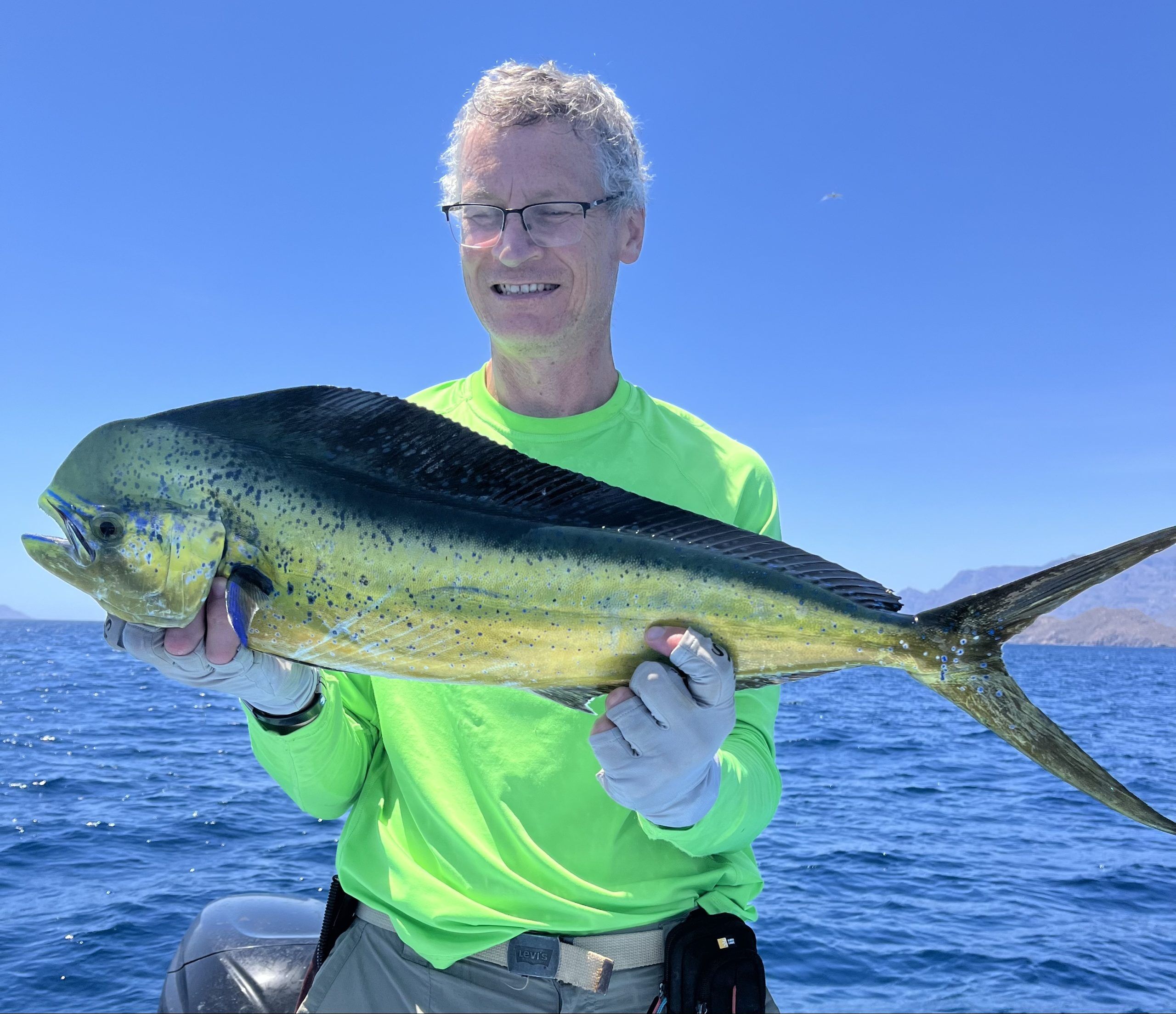
In writing for Hooked, Dale hopes to inspire and inform about places that are well
off the main highway. It also gives some purpose to the thousands of photographs
he takes and edits!
