

With over 35 years in the field, host Don Lamont covers topics and issues with industry leaders and influencers to bring you up to speed on what’s happening in the outdoor world. And now, here’s your host, Don Lamont.
Our guests on today’s podcast are Dr. Chris Summers and Julie Stewart. Stewart is a Master of Science student at the University of Regina. She’s studying the effects of catch and release ice angling on northern pike in southern Saskatchewan. She’s working with Dr. Christopher Summers, an applied ecologist who has a special interest in fish.
To better address fisheries conservation and management issues in central Canada, Chris started the Saskatchewan Sport Fish Research Group at the University of Regina in 2017.
So how did you end up at the University of Regina, Chris?
Well, you know, the Golden Horseshoe has the highest population density in Canada, and I wanted to run away from all those people and all that traffic.
And so I looked west, and I wanted to go somewhere where they had a lot of wildlife and fisheries challenges, somewhere where I felt like my science could really make a difference.
And so I ended up coming to the University of Regina for what at that time was a two-year position, a postdoctoral fellowship.
It’s called almost like an apprenticeship for professors.
And I spent two years in Saskatchewan, and I fell in love with the place.
And when a job opportunity came up in the Department of Biology, I applied for it and somehow convinced them to take me on on a permanent basis.
Well, you have also, you’ve formed a unique research group.
I’d like you to tell me about that.
That’s fascinating.
It’s all fisheries related, is it not?
Yeah, so my research program is actually multifaceted, so I study a range of different animals, and it’s all under this umbrella concept that people and animals interact with each other.
And sometimes we get the short end of the stick, or sometimes they get the short end of the stick, and I like to provide good information to try to get the best balance there.
And so I work on conservation biology, I work on wildlife management, and I work on fisheries conservation and management, all under that sort of general theme.
And when you think about it, fishing is really one of the more direct and interesting ways that people interact with animals, right?
So we have the opportunity to catch and harvest fish.
We have the opportunity to catch and release fish.
And there’s a wide variety of species and contexts available there.
And so that really fascinates me, that interaction and the science that’s necessary to make sure we do that right, to make sure that fisheries are around for future generations to continue enjoying.
Now, Julie is part of that program.
She’s one of your master’s students, correct?
That is correct, yeah.
So back when I first came to Saskatchewan, actually, I was working on issues with conflicts involving double-crested cormorants and American white pelicans.
Coming from Manitoba, you’re probably well aware of this kind of issue.
And I started working on fish as kind of a byproduct of that program because of, you know, people’s interest in how sport fish might respond to these birds being present.
And as the fish component became bigger and bigger, I saw a need for Central Canada to have, you know, a dedicated research program and a place where people who have questions about fisheries could come and say,
You know, we’re interested in this problem, but we have nowhere to go to get research done.
Can you help us?
And so that spawned the Saskatchewan sport fish research group, which is led by myself and has an ever changing group of graduate students, undergraduate students, staff volunteers that are involved in, you know,
The flavor of the flavor of research for the particular time period.
That’s really unique.
I’m going to ask Julie a question because we haven’t talked to her yet.
And how did, how did you get involved in this research group, Julie?
Yes.
So in my undergraduate, which I took at the University of Regina, I took a conservation course with Chris Summers and kind of learning about conservation, the concept behind it.
I became super interested in that field.
So then I watched a seminar that is also offered through the university, it was all focused on fisheries research, I found it absolutely extremely interesting and knew that I wanted to do something like that.
So I reached out to Chris Summers and talked about my interest in doing a master’s and he had this project available for me to study northern pike and I took it and I’m absolutely loving it.
Well, that’s great.
Now you, I understand you just finished up the program here with the season closing.
Yes.
So we just finished the ice season and my research is fully focused on catch and release of northern pike in the winter.
So what we’re doing is actually completing standardized field trials using four commonly used hooked styles.
So the reason why we chose these four specific hook styles is through Chris’s Saskatchewan sport fish research group on their Facebook page.
We created a survey and asked anglers what type of hooks they like to use when using tip ups to target northern pike.
So 295 people actually participated in the survey, so we got a good idea of what type of hooks people like to use.
There was an overwhelming response that they love double treble hooks when fishing for northern pike, as well as single and triple treble quick strike rigs.
And less used was the circle hook, but we decided to use the circle hook just due to its conservation benefit or the idea of conservation behind that hook.
So the four hook types that we use for my study were the single, double, triple, quick strike rigs, as well as the circle hook.
Well, that’s great now you’re gonna you’re ready to report for the next issue of Hooked magazine which spring issue, we look forward to that, but I got to ask Chris.
Chris.
How did you arrive on using hot dogs for bait.
Was that your idea.
That is a that’s a great question.
So.
People use hot dogs for me and I’d seen this around sort of folklore, if you like, and I tried it once when I was cooking up some sausages on a spring day for fishing with my kids for pike.
And a low and behold, you know, they liked it and believe it or not, I tried brisket as well and they like brisket to it seems to be this almost like smoky flavored meat that they like.
Yeah, and we wanted to give them a choice right so sometimes winter pipe can be finicky.
And so you offer them your your favorite dead fish bait and they don’t want it, but you give them a hot dog and man, all of a sudden they’re interested.
So, uh, this really evolved as, um, you know, from, uh, rumors in the rumor mill and then some testing in the field and, uh, finding out that, Hey, Pike really do like hot dogs.
Uh, I found out a lot of, about your research, including the hot dogs, you had West David down to, uh, do a TV shoot with you guys.
And, uh, he posted something on our, our fishing report about the hot dogs and had a shot of them with a tip up.
It was absolutely hilarious. That’s great stuff.
Well, the other thing that’s great about hot dogs is that if you can’t find a bait shop, uh, they sell them almost all the time in the fridges at gas stations and stuff.
So you can pick up a pack of hot dogs, uh, you know, almost anywhere.
Yeah. So Julie, when you, uh, when you hook a pike and you land it, you know, they’re all tip-ups, right?
Yes.
So you get a pike on the ice and you get the hooks out. What kind of research do you do with that fish?
Okay. Great question. So when we land the fish, we kind of have a specific set of protocol that we follow every single time to ensure that we’re collecting the same type of data every time we go out onto the ice.
So as soon as we capture a fish, we bring it to a bucket of water, place in the water, and we time the de-hooking.
So we also take into consideration the difficulty of the de-hooking as well as note if there are any injuries associated with the hook and the hook placement.
So then after that, after the hook is removed from the fish, we take measurements of the length, weight, and we just see if there’s any other types of tumors or anything on the fish.
As well as we tag the fish as part of our ongoing citizen science project. So other anglers, so recreational anglers, may recapture these fish and provide us information on the health status of the recaptured fish.
Cool. Now that’s not the only tagging program that you have, Chris. Now you have, what, six different species that you’ve been tagging for a long time?
That is correct. Yeah. So by far our biggest tagging program is for walleye and sauger.
You know, walleye is the king of the freshwater sport fish world in Canada.
So we spend a lot of our effort tagging walleye and asking about factors that contribute to successful catch and release.
And we work a lot with catch and release tournaments as well as with just recreational angling.
And we also tag northern pike, yellow perch, burbot, and we have probably a fairly unique program as far as I’m aware.
We work on Lake Cisco. So Cisco are commonly caught during the ice angling season in Saskatchewan and not much in the summer.
And that’s predominantly a catch and release fishery and nobody really studies Cisco.
They’re one of those species that people don’t seem to be all that interested in from a from a fish population point of view.
So we tag all six of those species and the unique thing I think about our data sets is that, you know, we’ve tagged somewhere in the neighborhood of 13,000 fish over the last the previous few years, and almost every single fish in the database has been caught by by angling.
So it’s not like a standard fisheries program where the majority of fish are going to be caught in live traps or some kind of monitoring survey.
These are all fish that are angled, released, and then we get reports back on when they’re potentially caught a second, third, fourth.
We’ve had fish even caught up to five times in this tagging program.
So we have to work extra hard to get those numbers because, you know, angling is definitely a less efficient way than netting to get your fish.
But my goal has always been to focus this data set around angling particularly.
How has the public participation been in the reporting of the tagging?
Yeah, it has been stellar.
I have been blown away by how great anglers have been about reporting information.
And this is a voluntary program, right?
So there’s no there’s nothing that says you have to report a tag in other jurisdictions like in the United States.
They often go with what’s called a high reward tag system where you pay anglers, you know, 50 bucks to report their tag return.
We simply don’t have resources for that here.
And but we haven’t really needed it because we’ve had, you know, over a thousand tag returns in the last four years.
Coming from anglers just out of interest and curiosity in the program.
And we treat it as an exchange of information.
So the anglers send me an email saying, you know, I caught this fish and I go to our database and I pull out the information that we have.
And I say, that’s great.
Thanks for the info.
Here’s what we know about your fish.
And everybody learned something that way.
And I think it’s been a really, really positive experience across the board.
So what does the future hold?
Well, more of the same.
We are hoping to get enough information that we can actually develop some simple indicators for deciding when a fish is good to release.
And so this sounds like a silly thing to say, right?
We don’t know as anglers.
We put a fish in the water.
We watch it swim away and we say, hey, that fish is great.
Right.
It swam away hard and we feel good about it.
But it’s not always the case that those fish make it.
And sometimes you have a fish in your hands and you’re like, geez, I don’t know.
This fish is not looking good.
And you kind of coax it and it swims away.
And you’re like, I don’t feel good about that release.
I don’t know if that fish is going to make it.
Right.
We’ve had both of those scenarios where the fish that looked strong died shortly thereafter.
And the fish that looked terrible was caught again four years later and had grown substantially.
So, you know, it’s not always clear when you’re going to have a successful catch and release event.
And that’s really the goal ultimately of the program is to say, OK, we’ve got all these species and all these different contexts.
If it’s summer fishing, if it’s winter fishing, it’s tip up fishing, it’s rod and reel, it’s tournament, it’s recreational.
What are the cues that we can use to decide, you know, this fish is good to go or this fish needs some help?
Or maybe this fish is not going to make it and needs to go in the frying pan rather than be a wasted release effort.
That’s really my overarching goal with the idea being that, you know, catch and release is a key conservation tool.
And we just have to make sure that we fine tune it as best we can so that as there’s more and more angling pressure, we don’t see a corresponding decrease in fish numbers.
Well, the good news, Chris, is there’s a whole lot of research being done on that in Western Canada.
In Manitoba, we have a number of programs.
Eric Mullen, he’s a regional biologist and out of Lactobani, did an article in the last Hooked issue on catch release.
And, you know, my experience over the years, and it’s great that you guys are working, Julian, your team’s working with Northern Pike because they’re, especially large Northern Pike, I believe are the most susceptible to damage while angling.
And when you went to a lot of these Northern Lodges in the old day and, you know, the, there was a vertical hold for the, you know, the big fish picture and all the organs are hanging down and they got their fingers in the gills.
And there was a lot of mortality of Pike after release.
I, I think that’s why the information, Julie, that you and, and your team at the University of Regina are doing is absolutely critical to, to survival of larger fish.
And that’s, it’s really great to hear.
Yeah.
So I, I agree with you, Don, I think that a large pike are, um, an issue for catch and release for sure.
And in both open water and winter.
And one of the things that, um, you know, is really quite interesting about the tip up study that we are doing is that the winter season is one that has only recently begun to be explored by fisheries biologists in this context.
And when you think about it, you know, um, how do you handle a really big ornery Northern Pike that you pull out of a hole in the ice?
Right.
Uh, it’s taken, uh, some trouble hooks in deep.
You know, they tend to clamp their mouth shut.
Uh, maybe the air temperature is minus 20 and you’re fighting with this big beast out on the ice surface.
Uh, it’s tissues are starting to freeze.
You know, it’s got air exposure.
Uh, you’ve got to pry its mouth open and maybe, uh, take some hooks into it.
Uh, take some hooks out in a way that’s rougher than you’d like because of the circumstances.
And then we’re going to try to put this back in the water.
Um, you know, it, it, the winter season really does present some extra challenges for fish that we just don’t understand.
Um, and I think the, uh, the set line or the tip up approach, uh, is it, it’s a different mode of fishing than typically done for big pike in the summer.
And, uh, you know, that, that slack line, that ability to run with the bait and potentially swallow it, um, is a real factor that, uh, we’re trying to understand in that research as well.
And you know what, it was just not for, uh, it’s just not for pike.
I remember in, in the old days, we’d go up, uh, say one of the great trout lakes we have in the Northern part of Manitoba, Saskatchewan.
And we said, uh, dead bait for lake trout on the bottom, and that would be a factor as well.
They would swallow it all the way down.
And we actually, uh, Chris stopped fishing that way.
I refuse to do that because we did have a fairly high mortality rate of those hook fish.
And I know we did because those fish are just not releaseable.
They’re, they’re bleeding from the gills.
And I, I just don’t think it’s a very sustainable way of fishing.
Um, I, I know that a lot of the anglers have, uh, have kind of adapted to how they set their baits with smaller hooks.
Uh, don’t let the fish run very long, that kind of thing.
But there is still an issue in that regard, I believe.
Right.
Well, maybe Julie should, uh, talk a bit about the circle hook then and tell, uh, you know, what our hope is for, uh, for that tackle in terms of that winter, uh,
um, and that very problem you’re talking about with swallowing the bait.
I’m all ears, Julie.
So the circle hook definitely had a learning curve that we had to overcome this season.
So at first we were following the same protocol with the crick strike rig, as we would go to the tip up within 20 seconds and start pulling it up.
No set for the circle hook, but we would lose a lot of the fish.
It would just pop right out of their mouth.
So after speaking with some anglers I have that are advanced anglers, um, we came to the conclusion that we actually had to let the northern pike swallow the bait completely before you start pulling it out.
And that’s just based on the design of the circle hook.
So you really want to make sure using inline zero offset circle hooks for this, because since it is being swallowed down, it needs to be able to come back out.
So if there is a slight offset, it will deep hook the fish.
So that perfect inline hook is the best.
And what you do is you just steady pressure.
So we’d let it run and then it would stop.
The stop would be an indication that it had swallowed the bait.
And then we would let it run again.
On that second run is when we start pulling up the fish and you could kind of feel it coming out.
And then it would hook the jaw of the fish, which is perfect for de-hooking.
It allows very quick de-hooking times.
The fish, they haven’t, they were not bleeding.
They were not having any type of injuries.
There was the odd deep hooking that occurred if it was slightly offset or if it was just missed.
If the hook was misplaced on the fish.
But other than that, there is definitely a conservation benefit to actually letting it swallow the bait.
So a little bit different than the quick strike rigs with all the trebles.
Well, that’s a extremely valuable information.
Now, when you use a circle hook, did you double circle hook?
Like, did you use a trailer as well, like a tandem?
No, we only had one circle hook.
Wow.
Yeah.
So we use a size 5/0 circle hook.
Okay.
Zero offset is absolutely critical.
So if there’s even a slight manufacturing deviance, which we find happens a lot, actually, you know, and the point is not dead on aligned with the shank of the hook.
So that’s a problem.
And so, you know, like Julie said, there’s a learning curve there.
But what I love about the circle hook is the it takes away some of that.
You know, Don, you mentioned that.
Okay.
Well, we’ll we’ll use smaller hooks or, you know, we won’t let the fish run as long or, you know, those are all kind of subjective things that puts a lot of the decision making in the hands of the angler.
If you use a circle hook and it works properly, all that goes away.
Right.
It’s like you can let the kind of kind of let the fish do whatever it wants.
And, you know, what my big concern with tip ups is often they’re not attended as, you know, directly as they should.
So guys are in their tent or in their trailer and they’re chatting or whatever, and a flag is up.
And, you know, you notice it who only knows when after it’s actually been, you know, the strike has happened.
The circle hook, you know, you can let the fish take it down deep and you’re going to pull it back out again anyway.
And it’s only designed to kind of come around the corner and hook in the jaw.
So I love that because it, like I said, it takes away some of that subjectivity, some of that decision making that maybe some anglers don’t just don’t have the know how, or maybe they lose that opportunity to make those decisions because they don’t notice when a flag goes off.
Julie, you’re going to have to hit the seminar circuit and, and tell anglers how we need to do that.
Yes.
That’ll be part of your masters.
Well, this was actually, you know, it’s funny.
Julie was not an angler, obviously, before she started.
And I think this, this was really good because she came in with no biases, no sort of angling folklore in her background.
And, you know, we gave her this and she’s able to go at it from a completely non-biased point of view and say, okay, how does this stuff work for me?
And, you know, to confess that, yeah, I struggled a bit with circle hooks at the beginning.
Right.
And I think, I think the same will be true for some anglers, right?
They’re going to miss some fish at the beginning because the circle hook is, you know, takes a bit of finesse.
So, uh, super, super good to have Julie on board.
Well, that’s, uh, that’s really great research.
That’s, that’s invaluable information.
I believe that’ll really, uh, that if we do it properly and get the information out there to the public, that’ll really increase, uh, catch and release success on tip-ups with Northern Pike.
I, I believe it, I believe what you, you know, what you’re telling me.
Right.
Well, that’s good.
We, uh, we don’t own a hook company yet, so we got no reason to lie to you, but, uh, I, I do want to add one thing to that, Don, which is, um, you know, there’s an older style of, uh, of tip-up hook for pike that’s used frequently.
It’s called a Swedish hook.
Right.
You probably, you probably know the one I’m talking about.
Yeah.
It looks like half of a coat hanger, basically.
That’s right.
Uh, these are still sold quite widely, but, uh, pretty well documented in the scientific literature that they have a high mortality rate for pike when they’re hooked on those, those Swedish hooks.
So, um, whenever I, I, uh, encounter Swedish hooks, I always, um, in a gentle way, try to have a conversation with anglers about, you know, what is the value of a Swedish hook?
And, you know, what is the risk associated with the hookup on those?
So I just wanted to add that, that those Swedish hooks are, are not a good idea if you’re planning to release fish from, uh, from tip-up fishing.
Okay.
Before I let you guys go, I’m going to ask Julie, uh, when, when do you graduate?
Um, so I’m looking to graduate in August, 2023.
So I’m going to have one more, uh, ice season to conduct some more research, a little bit more on selecting bait.
So I’ll be watching using GoPro cameras, the fish as they approach different size bait on different size hooks.
So that will be next season.
And just seeing how, uh, if there is a different size range that approaches them, how they act when they approach the bait.
And if there’s any differences at all that appear when using different hook sizes and bait sizes.
Well, I guess, uh, we’re booking the end for next April, then you should tell Don what an expert angler you are now, Julie, how many fish did you catch on tip-ups this season?
Hmm.
Hmm.
I definitely caught more fish than Chris, but my study this year, we caught 126 pike.
And last year when they did a pilot of my project, they caught 32.
So we have a total of 158.
Well, that’s a, that, that’s a good data set.
I would, I would think, right, Chris?
Oh yeah.
That’s great.
Yeah.
And if we, uh, we’ll, we’ll add to it next year, probably, uh, add another a hundred fish
to it.
You know, sample size is important because the more fish you study, the better your, uh, your data reflect reality.
And also, uh, in our case, you know, the fish range and size, right.
And I think there’s an important consideration for larger fish, like we were talking about.
So we want to make sure we get a good size range representation.
Um, you know, season may be important, right.
Uh, the way that fish feed during the deep winter and, you know, the aggression, uh, that they show in terms of striking may affect how often they get deep hooked.
So the season is important.
So there’s a lot of variables there to consider.
And, uh, if you want to do it right, you gotta have lots of fish.
Well, that’s great.
Uh, I really appreciate, appreciate both of you coming on the show and the tremendous work that you’re doing on research for not only pike, but all those other different species of fish in, in Saskatchewan.
Uh, I think the province is pretty blessed to have you Chris, to be honest.
Well, thank you very much.
I, uh, I appreciate that.
And, uh, you are, you have a standing invitation to come out and help us collect data.
Anytime you happen to be passing through this way.
Okay.
Sounds good.
And I’m going to have both of you back on the show again.
I really appreciate this.
Excellent.
Thank you very much.
Yeah.
Thanks for tuning in, visit hookedmagazine.com to subscribe to the complete angler and never miss an episode.
miss an episode.
Dr. Christopher Somers is a Professor of Biology at the University of Regina. Chris is an applied ecologist who works on critters of all kinds, but has a special interest in fish. His research program uses science to try and understand interactions between humans and animals. Given the huge interest in recreational angling worldwide, there is really no better example of people interacting with animals than fishing! To better address fisheries conservation and management issues in central Canada, Chris started the Saskatchewan Sportfish Research Group at the University of Regina in 2017. Students and staff in this group take on a variety of research topics on fish, and attempt to involve anglers in a data collection in a variety of ways.
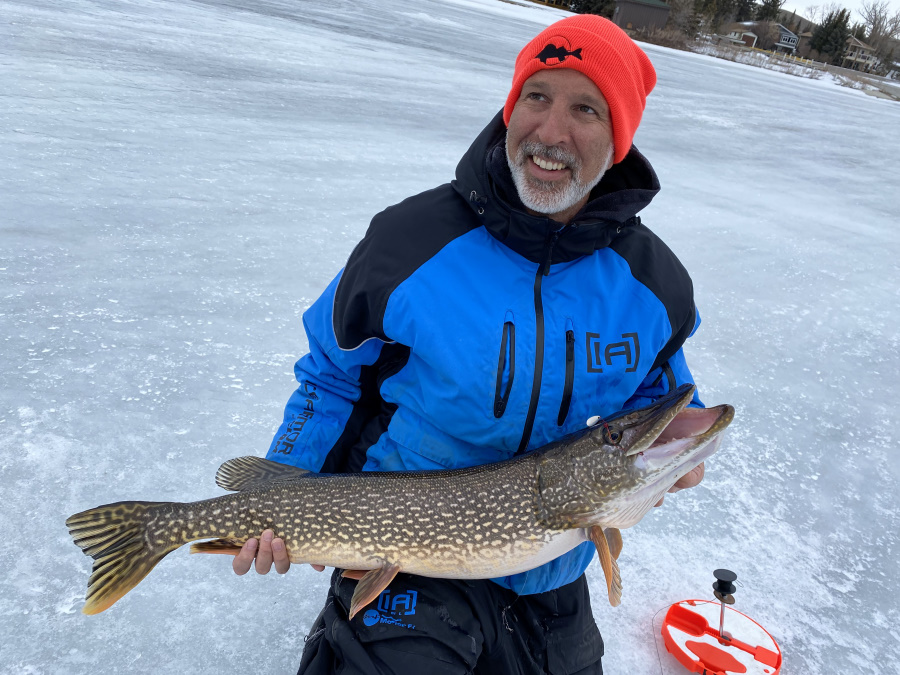
Perhaps best known is the long-term fish tagging program in Saskatchewan, in which 6 different species are tagged after being caught, and anglers report subsequent recaptures. Ultimately, Chris aims to help improve knowledge of fish ecology and response to angling to ensure that fishing remains a sustainable pursuit for generations to come.
https://www.facebook.com/SaskSportfishResearch/

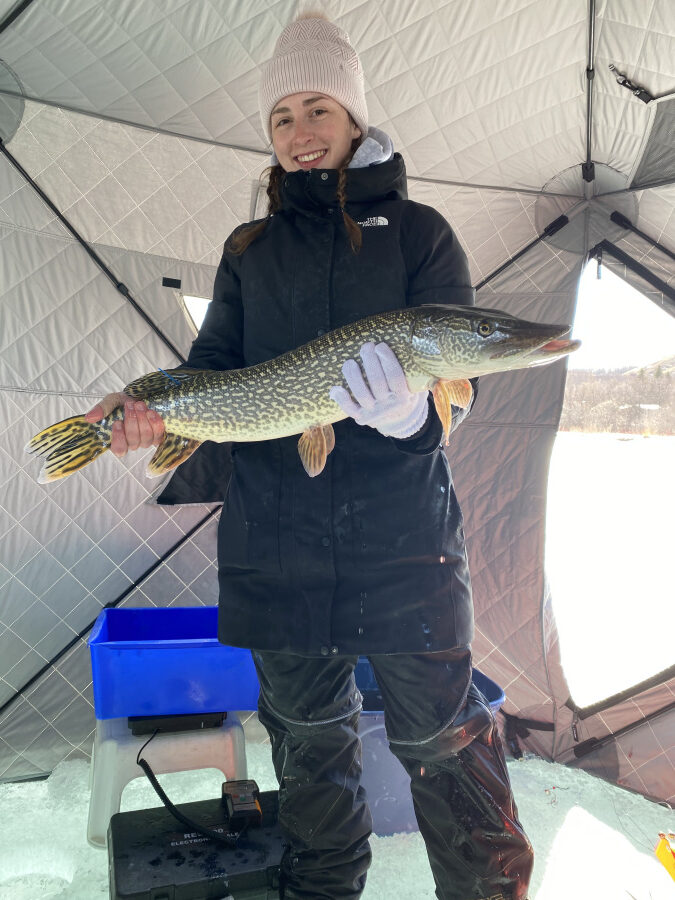
Julee Stewart is a Master of Science student at the University of Regina. She is studying the effects of catch and release ice angling on northern pike in southern Saskatchewan. Currently, there is little known about fish feeding behaviour in the winter and how they respond to catch and release. Julee aims at filling this gap of knowledge by completing standardized field trials using unattended tip-ups with four commonly used hook styles (circle hook, single treble, double treble, and triple treble). She will be analyzing field data, sonar outputs, and underwater video footage to determine relationships between hook styles, fish behaviour, and injury rates.
