



With over 35 years in the field, host Don Lamont covers topics and issues with industry leaders and influencers to bring you up to speed on what’s happening in the outdoor world.
And now, here is your host, Don Lamont.
Joining us on today’s show is Andrew Klein, a biologist with Manitoba Natural Resources.
And Indigenous Futures.
He is part of the team responsible for managing Lake Winnipeg and Lake Manitoba, two of Manitoba’s most important recreational, commercial, and subsistence fisheries.
Andrew, thanks for coming on The Complete Angler Podcast.
Hey, Don. How are you doing?
I’m doing well, considering that it’s not 40 below here in Manitoba currently, so we’re all good.
Absolutely.
I did a little bit of an intro on you.
You’re a biologist with Manitoba Natural Resources and Indigenous Futures.
How long have you been with them?
Just about two years now, Don.
Okay.
And what was your background coming in?
So, I did my undergrad at the University of Winnipeg.
Did a Bachelor’s of Science in Biology.
Then I just recently completed my Master’s of Science in Fish Biology as well at the University of Winnipeg.
So, yeah, I was kind of finishing that up as I was working.
So, it’s been a busy last year for sure.
Okay.
Cut down on your fishing time.
I understand you’re an avid angler.
Yeah, absolutely.
So, the fishing time was hurting.
I’m going to be getting back into that pretty heavy these days.
So, I’m excited for that.
And your bio said you grew up competing with your brother?
Yeah.
My brother’s also an avid angler.
Every year, we do the Kenora Bass International.
And we get out for lots of fishing together.
So, that’s always something I look forward to.
Okay.
That brings back a lot of memories.
I did the first KBI.
I can’t even remember how long ago that was.
It was a while.
I think it was in the 80s.
Oh, yeah.
Yeah.
I won’t date myself.
So, I was first after the first day of the first KBI.
Unreal.
Yeah.
Back then, it was just a two-day event.
And we ended up finishing the top 10, but we didn’t win.
But that’s another story for another day.
But it’s a fun event.
Now, the reason we have you on this show, because you contacted me about some of the work you and your partners have been doing on Lake Winnipeg with management of the resource.
One of them includes index netting.
So, let’s talk a little bit about how you go through the process of determined fish populations in Lake Winnipeg.
Absolutely.
So, yeah.
Our index netting program is quite extensive on Lake Winnipeg.
It’s around six weeks total.
So, we start in the South Basin, kind of make our way north.
Start in Grand Beach.
Then we move up to Victoria Beach, Hecla.
Go to Frog Bay and Matheson Island.
Make our way to Dauphin River and the Warpath River.
And then, finally, we finish off in Grand Rapids and Sturgeon Gill.
So, we get to see the whole lake, get to see it change as we move up.
And, yeah.
We set probably between 12 and 16 nets at each one of those locations.
So, we’re covering the water pretty good.
The whole program, we capture right around 10,000 fish each year, which is a lot.
But it’s kind of of all shapes and sizes.
They’re all a bunch of different species.
So, that’s including our small-bodied fish when we’re setting our small mesh nets there as well.
Using those numbers, we can understand what’s being harvested on the lake from an annual base or just from a comparative analysis there from each year.
We set them in the same locations at the same time of year so we can see trends from that.
Okay.
Now, that’s a pretty comprehensive list.
So, actually, it kind of follows the fish as they migrate north after spawning.
You know, when I interviewed Doug Watkinson from the Federal Fisheries and all this transmitter study on the walleyes,
it seems like a majority of the walleyes spawn in the red and then gradually move north.
Is that correct?
Yeah, I would say so.
I know we have, there are some lake spawners and some river spawners that the timing can differ a little bit with those.
But I know as well, there’s quite a bit of fish that go to right around Heckler area to spawn.
Right.
As you know, that area is pretty loaded with anglers in the spring taking advantage of that.
So, it’s a pretty awesome place to be.
But, yeah, the red for sure.
There’s some good spawning populations there and they’ll move after that is finished up.
Well, I don’t think many people would understand when you said the Warpath River, how remote that river is.
Because you have to launch.
I would assume you’d launch in Dauphin River and then head up with a boat?
Yeah.
Yeah.
So, that’s a big haul.
I believe it’s around like a 100 kilometer ride north.
So, we’re just, we’re flying up there.
We set our nets.
We usually only go, I guess, one day to set and one day to pull them up there.
But it’s a cool area for sure that has some big pike.
It certainly does.
Because I actually adventured up there in my boat.
Oh, wow.
One year.
Way back before I had my TV show.
And so, we had to, we got at the Warpath and it was really, really windy.
So, we stayed there overnight.
Not at the Warpath, sorry, at Dauphin River.
And so, we stayed at Anima Bay.
We stayed overnight and then we headed up in the morning, really early in the morning because the wind had gone down.
And then, we spent an overnight there and got back.
But it was a heck of a trip.
If anybody wants a real adventure, I would recommend it.
And yes, there are lots of big pike there.
So, interesting.
So, you got all these fish samples.
So, are there any surprises in the nets?
The kind of fish that you catch in the nets?
Yeah, there’s definitely some more unique species that I guess an angler wouldn’t typically see.
Stuff like lamprey.
We’ll rarely get those.
There’s three different kinds of lamprey in Manitoba.
The chestnut, the silver, and the northern brook.
But you’d only probably catch the, you wouldn’t catch the northern brook in like Winnipeg.
But yeah, so those are pretty unique.
What other interesting things do we see?
I guess the tadpole mad tom.
That’s a pretty cool fish that a lot of people have seen.
Similar to like a bullhead or a cat.
It does have some dangerous pectoral and dorsal fins there that they’re actually venomous.
So, those are pretty unique.
Other surprises that maybe you have to do more with the stomach contents.
We’ll see zebra mussels sometimes in the stomachs of whitefish.
And we’ve even seen them in yellow perch, actually.
So, we don’t think it’s really like a preferred food source.
But it’s something that they do secondarily use.
We’ll see.
I’ve actually seen a northern pike in a walleye stomach.
Which is pretty cool.
Because usually you assume that, oh, the pike are eating all our walleye.
But I guess it does flip the switch there sometimes.
Yeah, well, the walleye is a pretty aggressive predator.
One question I would have, since you mentioned zebra mussels.
How bad are they up in the north basin?
I know they’re really bad around Hecla.
Yeah, they’ve definitely made their way up north.
You can almost tell, like when we’re in the south basin, they’re quite a bit larger.
As we make our way north, you can almost tell they’re not quite as developed up there.
But they are still quite abundant.
Now, you mentioned that there seems to be a slight resurgence of rainbow smelt in the north basin.
Maybe you can talk about that a little bit.
Yeah, definitely.
So, we’re not really sure if they’re starting to come back.
There’s possibly a trend there.
The last couple of years, we have started to see a comeback in our small mesh nets.
Although our small mesh netting program is not quite as comprehensive, I guess, as our typical index netting.
But I was chatting with a buddy of mine at the Lake Winnipeg Research Consortium, and they have also started to see smelt in their catches the last two, three years as well.
So, maybe we’re starting to get that comeback, but I don’t think it’ll be to the same extent as it was during that initial boom.
Yeah, and that was responsible for a lot of rapid growth of the walleyes in Lake Winnipeg, for sure.
How many large walleyes would you get in your index netting?
You know, that’s something that when I first took this job, I was all excited.
Like, oh, man, we’re going to get to see all these giant 32-inch-plus monsters all the time.
But it’s not actually the case.
And that’s not because they’re not there.
It’s just because of the mesh sizes that we use.
So, our meshes are usually between an inch and a half and six inches in our index nets.
So, they just don’t capture those giant walleyes just because of the shape of their head and the size of it.
It just won’t fit through the mesh that we use.
And we don’t really have a desire to capture more of those.
Like, we maybe get three or four a year of those master size that we’re harvesting for our data.
But we kind of already understand that those fish are critical to the fishery.
They bring in anglers.
They’re great spawners.
So, we don’t really have a need to go out and set larger mesh sizes to catch more of those fish.
Yeah.
Speaking of that, I mean, part of what you do when you do this netting is you test for the size and the age, right?
So, for example, your slot size fish, which now are 35 to 55 centimeters on Lake Winnipeg, how old would they be?
So, the slot size fish on the lake are generally going to be between around 5 and 14 years old.
So, that is a good age range.
This allows, like, a good chunk of those fish to reproduce before they’re actually being harvested.
There is a large amount of variation.
Like, for example, like a walleye that’s 45 centimeters could easily be 6 years old or it could be 12 years old.
So, you can’t really know for sure just by looking at the length and weight of a walleye.
You really have to cut them open, extract those aging structures from them to really be able to figure that out for sure.
One thing that is looking good right now is we have a large amount of, like, 15-year-old fish, 15-year-old walleye in the lake right now.
So, I guess over the next kind of two or three years is going to be a great time to be catching master-sized walleye.
Well, nice to hear.
Well, wow.
I like it.
There’s a few things that affect fish growth.
Obviously, it’s, I think, one of the things that might be helping those walleyes in Lake Winnipeg is the fact that you’re seeing so much better water clarity now with the zebra mussels.
I know back in the old days when I used to try and fish Lake Winnipeg around Heckler, the water was so dirty.
I don’t think a walleye could see your lure unless it was one inch off its nose.
So, and that’s, you know, that’s changed.
There are places there you can see down six, seven, eight feet.
So, has that made a big difference in the feeding effectiveness for the walleyes?
I think it could play a factor in their ability to see and consume bait, like, visually.
But as far as, like, affecting their growth and just, like, the population in general, sometimes those nutrients can actually be a good thing.
Especially just because it can affect the forge availability.
Like, with it being such a eutrophic lake, all those nutrients are going to be consumed and kind of utilized by the plankton base, which is going to be used by the small fish.
And it kind of just works its way up the population.
So, although you don’t want water being too dirty, but having some excess nutrients to the water can be good for the forge base and fish growth overall.
Yeah, yes, I can see that.
What about fish growth between north and south basin?
Yeah, we have a pretty good idea that there are some differences between that north and south basin there.
So, we see, well, I guess, first of all, we know the fish move.
So, it’s kind of challenging.
Like, we do delineate as two at a north and a south stalk because there are distinct differences there.
But we understand fish move from the telemetry studies and stuff that Doug and others have done in the past.
So, we understand that.
That being said, the south basin walleye are actually growing faster and maturing quicker than those north basin walleye by about a year.
Well, that would have to do a little bit also with water temperature, right?
Yeah, definitely.
Yeah, that definitely plays a factor.
Yeah, so quicker growth.
You know, back in the old days, I know when those walleye were feeding on smelt, the walleye were almost as long as they were fat.
Oh, yeah.
I mean, they were big, thick, heavy fish.
I remember catching them on the Red River in the fall time.
Unbelievable.
Oh, yeah.
You could have a 28-inch walleye that was like 12 pounds, like it’s crazy.
So, yeah, they’re not quite like that anymore, but there’s still lots of beautiful fish, that’s for sure.
Now, there’s pretty substantial, you know, angling pressure on Lake Winnipeg.
So, is part of this data collection, just to get a handle on that, and do you use all this angler pressure to gain data on the fish populations?
Yeah, definitely.
So, with, I guess, angler data, I’ll start there.
We do what are called creel surveys, which many anglers here probably experience when you’re rolling out to some of the popular access points in the lake.
We’ll be there with different questions and just trying to gain information from the anglers.
We’ve done a few of them on Lake Winnipeg in the past.
Currently, we’re actually running one on Lake Manitoba, to where we kind of, usually like five days a week, we’ll set up at those popular access points.
And we’ll ask a bunch of questions, pretty much.
We get an understanding of, I guess, the total harvest, the angling pressure, some of the angler trends.
And with that, we can kind of figure out the economic and social value, perhaps, of that fishery.
So, yeah.
Okay.
Yeah.
Speaking of Lake Manitoba and the creel survey there, has there been many anglers out on Lake Manitoba this year in ice fishing?
Are the conditions pretty tough?
Been kind of up and down, especially with the recent storms we’ve had.
But, yeah.
So, we have clerks at Steep Rock.
We have clerks at Twin Beach and at Delta Beach.
And Steep Rock hasn’t been as busy just because there’s not drive-on access right now, at least where we’re situated there.
So, it’s just been mostly snowmobiles and cottagers there.
Okay.
But Delta Beach has actually been pretty busy.
Lots of people coming up from Portage and just all around there.
Twin Beach as well has been quite busy, people driving on.
But not quite to the same extent it would be for Lake Winnipeg.
Is Lake Manitoba kind of a hidden gem?
Yeah, definitely.
It is an absolute walleye factory.
Like, the fish there grow so fast, mature so fast, even compared to the South Basin, Lake Winnipeg walleye.
So, it’s a pretty cool fishery that I don’t think gets as much love as it should.
No, and if you ever went into, well, if you ever got a map of the South Basin that was done a while back that actually outlined some of the depth changes, you saw the structure that was up towards the narrows there.
You’d be blown away.
Oh, yeah.
I know some people that fish that area, and it’s just, like, incredible fishery.
So, it’s still very untapped, but certainly the word is out on Lake Winnipeg, and it’s such an important part of this.
Now, I know that, maybe most people don’t know this, but I know that your department is really trying to collect all this data so that eco-certification can happen.
Is that correct?
Yeah, definitely.
Yeah, that’s been on our radar for a couple of years now.
And how are we doing on that?
It’s coming along.
There’s definitely some challenges along the way, but, yeah, we’re slowly making progress, I think.
Well, that’s good to hear.
Anything else you wanted to add, Andrew?
Maybe, I guess, chat a bit about how we kind of utilize that information to kind of come up with our stock assessments.
So, we kind of, the two main things we consider with those are the commercial fishing data, like the commercial fishing production, and kind of the information from our indexing surveys.
So, that’s kind of the big two.
We also, of course, consider those creel or those rec angling surveys, but, yeah, those are the two main data points to figure out where we’re sitting at for our fish populations.
We have, like, a whole team of stock assessment biologists that figure out the populations.
And I guess the other thing I wanted to mention is that all this information, all our index netting data is available on our website, so manitobafisheries.com.
So, anyone can go and play around with that and just look at what we’re catching in our nets and how many we’re setting and stuff like that.
We are, I think, a couple of years behind on actually uploading our indexing data just because it’s such a massive data set.
But it’s definitely something worth checking out if you’re interested.
There’s a couple other interesting things on there as well, like some other random reports.
The Eastern Region guys have been doing a good job of uploading little small reports on different lakes in the White Shell and the Nopme and stuff.
So, if you’re an angler that frequents that area, definitely check those out.
We also have, I guess, the Angler’s Guide and something called LEFA, which some people might know about, which is lake information for anglers.
So, it’s sort of a software that has, like, bathymetric maps and all our stocking information for the different water bodies in the province.
So, it doesn’t work too well on a mobile device, but it’s definitely worth checking out on a computer.
Yeah, I spent a lot of time on there.
It’s good.
It’s hard to find, though.
But we will put all that information on the end of this, on this part of this podcast.
So, the people out there that are listening to this will be able to find all that information.
So, final question for you.
How are the walleye populations and how is Lake Winnipeg doing?
Overall, pretty good.
The walleye populations are great.
Right now, we’re pretty loaded up with fish to the point where there’s almost, like, too many walleye in the lake.
And we’re possibly starting to see some density-dependent factors just from having so many fish.
The whitefish are down a little bit.
We don’t have a ton of mature whitefish in the population, but we’re seeing quite a few that are about to come up into those reproducing years.
So, I think we’re going to be all right.
But right now, the whitefish populations aren’t doing as well.
So, I’m going to ask you an angling question now.
Go for it.
How come most anglers on Lake Winnipeg cannot catch Lake Whitefish?
You know, that is a good mystery.
Because, I mean, you hear of lots of guys in Ontario and stuff, like, just hammering whitefish.
But here, it just seems to be a random thing where you’ll catch one out of nowhere.
But I don’t know of really anyone who can go on Lake Winnipeg and target them and do well.
So, I don’t know.
Maybe they’re just different.
I don’t know.
That’s a mystery to me still.
Yeah, and the mystery to me is where all the white bass went.
That as well.
Do you ever get any in your index netting?
We actually caught the first one that we have in nine years this year, and it was probably about three inches long.
And it was kind of near Matheson Island.
So, I don’t know.
We don’t know about that as well.
It’s kind of a mystery.
Yeah, that’s strange.
One of the other interesting things is the number of channel catfish being caught on the Red River this winter.
Yeah, people are catching them pretty good.
I’ve been following the master angler there and seeing that.
It’s been cool to see.
Yeah.
So, on my last fishing report, I published a video that James Linder had done on how to catch catfish.
They catch a lot of them through the ice down in Minnesota, North Dakota, South Dakota.
And they’re actually fairly easy to target.
And I kind of know where they hang out on the Red River.
They go in those deep pockets, right?
And you can find them and you can mark them all, but you better be prepared because they’ll stretch your line if you catch one.
Absolutely.
Andrew, so what does the future hold?
What’s going to happen in the next four or five years?
For the fishery or for myself?
No.
How about both?
Let’s go with the fishery first.
I don’t know.
We’re going to continue to do our monitoring programs, keep an eye on things.
But, yeah, like I mentioned, there’s going to be a good amount of big walleyes around.
So, anglers have that to look forward to for the next couple of years for sure.
Nice.
What else?
Yeah, we’re just going to keep chipping away, keep making sure we’re managing the fisheries populations well and for the future.
As far as myself, I’m going to keep doing what I’m doing here.
Okay.
And spend a little more time angling now that you got your masters out of the way.
Absolutely.
Yeah.
There’s going to be a lot more fun stuff going on, a lot more fishing, a lot more hunting.
So, I’m going to be, you’ll find me outside most of my life from now on.
All right, sounds good, Andrew.
Thanks so much for coming on the show.
No problem.
Thanks a lot for having me.
Thanks for tuning in.
Visit HookedMagazine.com to subscribe to The Complete Angler and never miss an episode.
Andrew Klein has been fishing since he could walk, growing up competing with his brother over who could catch the most fish. He enjoys hunting and fishing throughout Manitoba and at his family cottage near Kenora, Ontario. This upbringing inspired his passion for working with and managing the fisheries he values so deeply. Andrew enjoys targeting a wide variety of species, with favorites including Smallmouth Bass, Lake Trout, and Muskellunge.

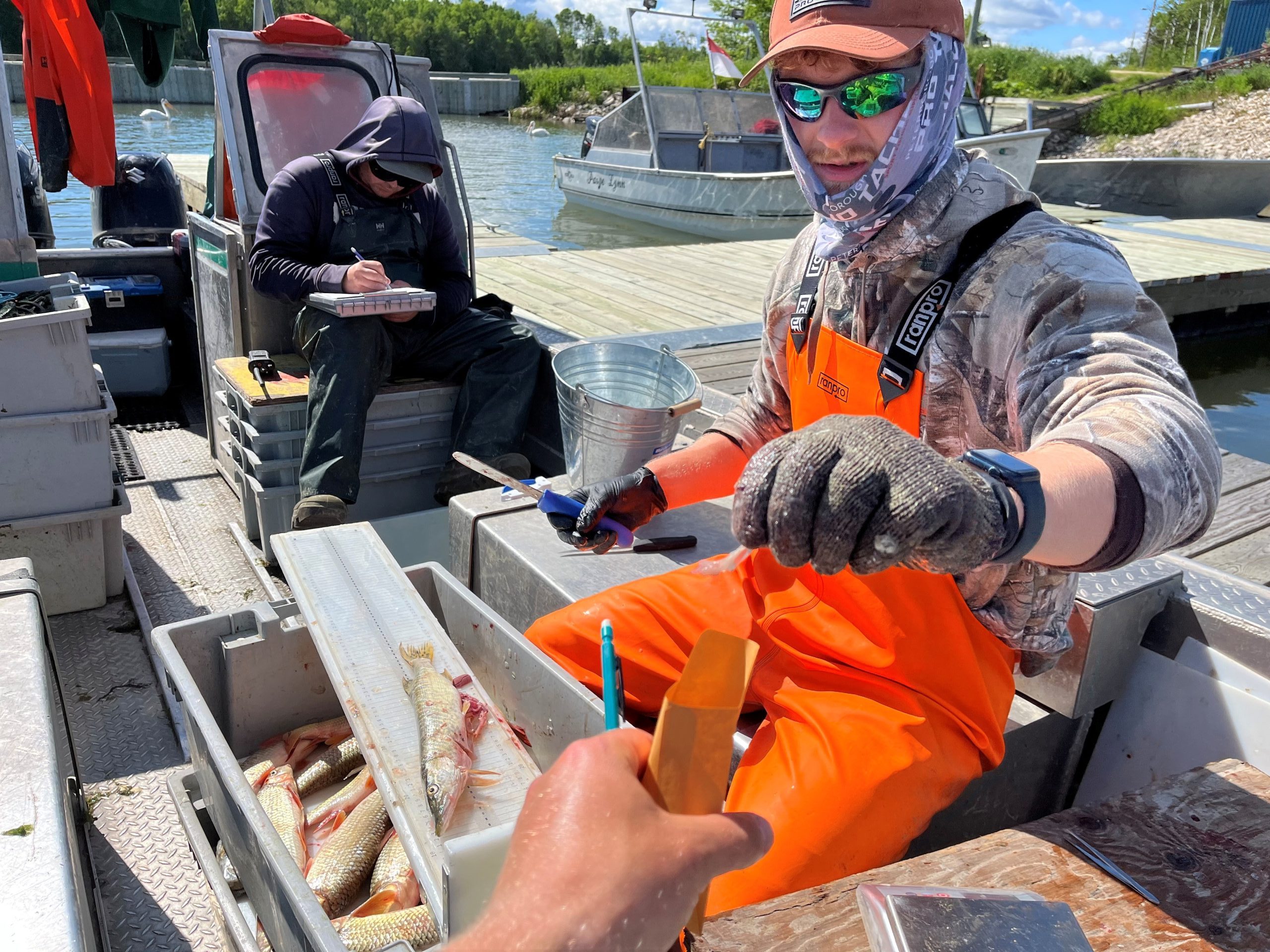
He is currently the Central Region Fisheries Biologist with Manitoba Natural Resources and Indigenous Futures, where he is part of the team responsible for managing Lake Winnipeg and Lake Manitoba, two of Manitoba’s most important recreational, commercial, and subsistence fisheries.
Andrew completed both his Bachelor of Science in Biology and his Master of Science in Environmental and Social Change at the University of Winnipeg.
