

With over 35 years in the field, host Don Lamont covers topics and issues with industry leaders and influencers to bring you up to speed on what’s happening in the outdoor world.
And now, here is your host, Don Lamont.
Welcome to the Complete Angler podcast. I’m your host, Don Lamont.
On today’s episode, we talk to lodge owner Cindy Ouellet.
Cindy and her husband bought T&D Amos Camp in 2019 to get away from the everyday work week.
Little did they know that COVID would hit six months later.
As Cindy talks about in this episode, it allowed them to work full-time on doing renovations to the property.
With a background in marketing, Cindy used all her skills to get their new lodge on the landscape.
Now they are reaping the rewards.
Well, good day, Cindy.
Thanks for coming on the Complete Angler podcast.
Thanks.
I’m happy to join you and have a good conversation.
Well, I want to give a little bit of background while I have why I have you on this podcast,
because we got to know each other and your husband.
About 2019, when you reached out, you had just purchased a fishing lodge in northern Saskatchewan.
And you want to do some advertising with Hook magazine.
And so I know, first of all, we had a conversation with our publisher, Kevin Stobbe.
And then I got involved, and it was really fascinating to watch your journey since 2019 to now.
And one of the things that really interests me in the industry is how people market themselves.
How do you market your lodge?
How do you let people know that you’re in business and that you’re a good operator?
And then we met you and your husband at the Saskatchewan Commission of Professional Outfitters AGM about three years ago, wasn’t it?
Yes.
Yeah, absolutely.
It was nice to start to see some faces after, of course, the COVID shutdown.
That was the first AGM we got to go to.
And it was nice to finally see some faces and put real people to the voices and emails.
Yeah, no kidding.
So anyway, yeah, so it’s been a really interesting watching you and your lodge expand and become more successful.
But what initially made you buy a fishing lodge, Cindy?
You know, it was May of 2019, and my dad had shared a Facebook post about a fishing camp that was for sale up near Creighton,
which is where I grew up and where my dad currently lived.
And I saw the post.
I read the information.
It was a Realty Facebook post.
And I showed my husband, Nick.
And at the time, we currently lived in Hinton, Alberta.
And he worked in the gas field.
I worked for the government of Alberta.
And we had full-time jobs.
And I can honestly say we weren’t looking to buy a fishing camp.
It was not really on our radar.
However, we both have backgrounds in tourism and in outfitting and in outdoor pursuits.
So we didn’t actually have a solid plan to buy a fishing camp.
In fact, the week before, I couldn’t have told you that that would have ever been in our future.
So there may have been a, you know, we did probably have sort of an informal idea that at some point in our lives,
we may be more as a retirement, we would both like to get back more to an outdoor plan
and likely a business of some sort in the outdoors.
But I cannot say we were out looking to buy a fishing lodge.
So, I guess your timing couldn’t have been worse.
Now, this is right just before COVID hit, right, Cindy?
Yeah.
So, really, it was May of 2019.
And when we saw the ad, I think we just sort of both said we were ready for a change.
It may have just been the right day, the right time.
We were both very busy with our jobs.
We had very little time off together.
And we missed being outdoors.
And so, we saw that ad.
We visited the property within two weeks when we were able to arrange time off to do the 15-hour trip out.
And, you know, we made an offer on the spot.
And three months later, we were standing on the shore of Amisk Lake at our own fishing camp
as the new owners living on site.
And that was September 2019.
We had no idea that within the next six months, we were going to be standing alone in the middle of a summer
in our very own fishing camp with no people.
So, yeah, timing was very unique.
So, how did you reload?
Did you take that opportunity to do work around the camp, fix the place up a little bit?
Or how did you go ahead?
Well, what we did is, you know, we were prepared, I guess, we were prepared for the life of camp.
And we knew it was all going to be new.
But we definitely weren’t prepared to jump into it, into a pandemic.
And so, we ended up spending that very first summer, of course, that was when it was mostly shut down.
There was very limited travel, even within the province of Saskatchewan.
And definitely not cross-border.
So, we spent that time doing a lot of work.
That’s exactly it.
We did not have a lot of money because there was not a lot of money coming in.
However, what we did have was time.
And we took that time to get to know the camp and the lake and the area.
And to assess the camp as it was and figure out how we wanted it.
And then we just got to work.
And we just started doing all the physical work that we could.
And that was, in some ways, you could say it was a silver lining to have that time in the camp as a new business to really get our feet on the ground.
And it was a bit of an older camp as well.
So, Cindy, you had quite a bit of work you had to do.
Yeah.
Yeah.
It was.
The cab has been around since the mid-1950s.
And so, there was cabins and buildings on the property of varying degrees of newness.
And so, we just sort of started making lists of what we wanted to tackle in terms of whether it was completely rebuilding or renovating what was there.
And we just looked at projects and in terms of what the cost was.
And we were both fairly handy, mostly Nick.
And we figured out what we could do ourselves and what we could take on with limited investment for the time being.
So, that involved renovating, you know, minor renovations, lots of painting, just lots of repairs and making the camp a little bit more what we saw as comfortable.
And where we wanted the direction of the camp to go.
We, yeah, it definitely lots of work.
And it gave us, it really did give us the time to figure out what it was going to look like once we were able to start welcoming guests back into camp.
Well, the most important thing, I think, is it also gave you time maybe to organize how you wanted to market your camp.
Because I think you’ve done a wonderful job of doing that and letting people know who you are, what you do.
So, what were some of the keys in your marketing approach going forward from there?
Well, when we purchased the business, it was 95% U.S. guest base.
And we were very lucky.
We were able to purchase a business that had a longstanding good reputation and a very strong repeat guest base.
However, 95% U.S. meant 95% of the guests that were booked to come that first summer of 2020 slowly disappeared.
Week by week, day by day throughout the COVID pandemic, those trips got canceled.
And so, we very quickly realized that we needed to market the camp based on who could come.
And being a new business to us and going into it with the assumption that the books were filled, bookings were there, people were coming, they were repeat, they were just going to show up.
And we basically just had to be there to run the camp.
And the people would arrive to all of a sudden needing to learn the business and figure out what it was and how to attract new people who’d never been to the camp.
And so, quickly determined that we needed to build a website, and it needed to be very accurate.
And it needed to explain exactly what this camp was all about in order to attract people who’d never been here.
There was a lot of information out that, of course, Canadians were going to be the first ones to travel.
And so, we knew there was going to be people looking for trips, but we needed to be able to show them what they were going to come to and explain what camp was all about.
Yet, we didn’t actually entirely know all of that ourselves.
So, the website got built, I took a lot of pictures, I took photographs of all of the cabins, and I clearly explained as much about the camp as I could.
And we put it into a website, into social media, and had to get the word out, of course, first to Saskatchewan, and then the other province that was the most broad travel allowances was Alberta.
And so, we needed to not only show them what the camp was like, tell them what it was going to be like when they got here, and what fishing was like, but also go through the whole safety protocols that were required for COVID, and figure out how that was all going to happen, when we actually hadn’t really been here for a full summer season to know.
So, it was quite daunting, in terms of trying to figure that all out, and when we yet actually hadn’t experienced it ourselves.
So, we managed to do it.
We also worked very closely with the SCPO, Saskatchewan Commission Professional Outfitters, during that time, and relied on them as an industry voice,
in terms of looking for support for COVID, and working with the government to make them understand the importance and the loss of income that was going to happen to the outfitting industry.
But we also were able to rely on experience of other outfitters going through this process, who at least had the experience of running an outfit.
To help guide us with some of the questions we had to help guide us with some of the questions we had on how to address what was going to happen when people did start to show up.
So, that was invaluable, that connection.
So, when did the tide turn for you guys?
You know, the first summer of 2020, we had a small handful of Saskatchewan guests who came.
And that was a very slow start.
I’m going to say there was probably five groups that came.
And so, it was not that summer.
That year and then that winter, we did see that there was going to be some improvement,
although there was not a clear answer whether the border to the U.S. was going to be open.
So, we heavily marketed to Saskatchewan and Alberta
in the hopes that for the summer of 2021,
we could at least recover some of the business.
And it was successful.
So, we did marketing, like I said, our website and social media marketing and print marketing
through magazines such as Hooked to attract Canadians.
And it was good.
You know, we definitely stepped up the game.
We had groups booking in.
We offered booking incentives.
We had discounted prices.
We pulled out everything that we could to get people.
And I can say we had a reasonable summer.
And then in that August, August of 2021,
mid-August is when the U.S. border opened.
With restrictions, there was definitely still not a smooth process.
But guests were able to start coming up from the states.
And we experienced very, very thankful and happy U.S. guests who could return to camp.
Because the guests that come to this camp,
some of them have been coming for up to five generations now.
And this is a staple in their life.
And they had to miss it in 2020.
And for some groups, they have never missed a year coming.
And when they started being able to go through all the hoops
and pass all the checks to get through that border,
they showed up and they were so happy when they arrived.
And so we were able to, kind of the last two weeks of August and the month of September,
we were able to see those first vehicles pulling in with U.S. plates.
And it was a happy moment for everyone.
Although not one without issues.
There was still a lot of paperwork and a lot of process to go through for them to cross that border.
But it really showed us their determination to do so
and how badly they wanted to continue their fishing trips.
So how did, during this time, how did Tourism Saskatchewan fit into the picture?
They provided a lot of support.
And that came in different ways.
So they had a lot of webinars and they tried to bring in as many training opportunities
and Zoom courses and webinars to help provide information for marketing to businesses.
And they worked with a couple other organizations to develop a program called Clean It Right
to go through training for cleaning procedures for COVID.
So then you could advertise your business as a Clean It Right certified business
to help provide the safety aspect for people coming.
And they had a lot of business support in terms of grants.
So they offered a training, sorry, a marketing grant.
And that marketing grant helped with marketing costs to do the exact things that we needed to do,
such as expanding or building a website,
photography in order to showcase what you had,
and marketing.
So in terms of traditional marketing in magazines, in billboards, newspapers,
and then digital social media marketing,
when we’re talking Facebook and Instagram and YouTube.
So the sports were really there to help get the word out.
Them as Tourism Saskatchewan also had a very strong marketing campaign to try and encourage people to travel
and explore the province.
Of course, you know, explore what’s in your own backyard.
And we were so thankful for that.
That made a huge difference for us.
We went into the business and bought it and went in with the expectation that we would be reaching some of these goals of marketing
and targeting a different audience and updating websites, all of that down the road,
but definitely not within that first six months, 12 months.
It jumped our business forward very quickly.
Well, yeah, I’ve seen the evolution of that, been in the industry for 44 years.
And, you know, when I took over as editor of Hook magazine, Kevin and I,
we really had to understand social media as well.
So at the Manitoba Lodges and Outfitters conventions,
they had very similar things on marketing as Tourism Saskatchewan did.
So it was all about all the pieces of the pie.
And the reason I’m pointing this out, because if there’s any Lodge Outfitters out there
and they want to understand anybody, want to expand their business,
you use all components of social media.
So whether it’s Instagram, Facebook.
One of the things I really like about your operation, Cindy, is the newsletter you send out.
It’s informative.
It brings people up to date.
It tells people what you have to offer.
For example, since 2019, you’ve expanded to things like ice fishing in March,
snowshoe adventures, checking out some of the history around the lake.
There is a lot of history on Amisk Lake, is there not?
There is.
Yeah, it’s a very active lake in terms of historical significance,
because the Sturgeon Weir River feeds into and out of Amisk Lake.
And the Sturgeon Weir River was the main highway for travel,
for trade and gold rush era, as well as prior to that.
So it has been a highway for time immemorial.
And so basically, any explorer who is headed north at any point in time
used Sturgeon Weir River and thus Amisk Lake.
So yes, there’s a whole pile of history there that we enjoy sharing and promoting.
But yeah, that was definitely another part of COVID that we did look at.
And in terms of setting ourselves apart, because now all of a sudden, as well,
you have all these businesses that they all offer fishing.
So how do you set yourself apart?
And so we did look at what other experiences we could offer to people to make the trip a little
more interesting.
We know the fish are here, but what else can you do while you’re here?
And so, you know, history, going for walks, all the outlying activities that you can do in
the area is part of what we looked at and figured out how to market.
And I have to say, as well, Tourism Saskatchewan, another program that they have is a diversification
program.
And that is what helped us to look at some of these other opportunities.
And they have a grant program that helped us make them a reality.
So in terms of taking a business that was traditionally just seasonal summer, we were able to get a grant
to build a washroom building that was year round.
And so then that made the option of having ice fishing, winter trips, snowmobiling trips, winter
activities, a lot more feasible when there is a washroom building versus an outhouse.
So they were instrumental in that, as well as very encouraging of opening our season up year round
and offering these different activities and partnering with other local businesses to make the trip
itself a lot more interesting when you can combine it with other activities and events.
I think that they learned that long ago in Europe about how to combine with other businesses.
And it makes it so much better for everybody else.
But just a little interesting background.
I was up there, did a show on Amosk Lake at another lodge at the time that was open.
I don’t think it’s any longer open, but it was really interesting.
We stopped and we went to an island.
I think it was a gold, old abandoned gold mine.
There had been, been there on one of the islands.
We had a, one of the locals artists was a birch bark biter and we had her on the show.
It was fascinating stuff.
So, you know, diversity it’s there.
It’s a, it’s a smart thing to do is, you know, get partners and everybody can be more successful.
So good on you, Cindy.
Very well done.
Yeah.
Thank you.
It has been fun.
You know, it definitely makes it, it makes our, our job and our life interesting.
And we like working with other people and you know, it’s definitely a passion of mine to work in the tourism industry and to help other tourism businesses succeed.
And so that’s something I definitely strive to do and, and get the word out to what we, to what we offer.
Yeah.
And you touched on the newsletter that, that actually also came out of COVID and a marketing company we were working with at the time had flagged that and said, you know, everybody is stuck at home on their computers right now.
And they are desperate for something new to look at.
And so they said, we are seeing a resurgence of email marketing and you should do this.
So we started setting that up and it, it absolutely has been a huge success.
We get numerous mentions about it regularly that people love keeping in contact and not everybody’s on social media.
And the email is just a way to make them feel like they still know what’s going on at camp when they’re not here.
So, uh, that’s, that was a very pleasant surprise.
Uh, and I do enjoy doing them every month.
Well, here’s a question for you.
Do you ever get to go fishing?
Well, um, you know, I have to say that I don’t very often, but in all honesty, I am not a diehard fisherman.
So, um, you know, they say if you, if you absolutely love something, you maybe shouldn’t go into business because you’re for it because you’re never going to do it.
So you have to, uh, you have to know and accept that if you love something and you want to keep doing it, you should do it as a hobby.
And, uh, I don’t think anything is truer than someone who owns a fishing camp.
Uh, there’s very little time to go fishing.
I’m lucky if once a summer I get out on the lake, uh, fishing and, uh, I do get the chance in the winter to ice fish.
And so I would say that’s the most time I have for fishing and, and enjoy that.
Um, Nick is very passionate about fishing and he’s had to accept that he won’t fish as often as he likes, but he does try to get out, um, as, as much as he can in the summer.
He’ll sneak away for an hour or two here and there.
And, uh, so he does get out there probably more than he expected he would, but not as much as he would like to.
And, uh, he claims when he goes out, he has to research, which, which I’ve learned is very valuable.
And so he, uh, he, he gets to go do his research as often as is possible.
That’s good.
Good for him.
Yeah, I mean, uh, I, I think that’s great advice.
If you, if you love fishing, do not buy a fishing lodge.
I, I started in the industry at Eagle Nest Lodge as a guide.
And then my second year, uh, uh, the lodge owner needed a manager there as well.
So I was guiding and managing.
So, you know, that turns into 18 hour days and it’s, it’s a lot of work and, uh, but you know what, uh, it’s a passion and, uh, you know,
luckily I was able to translate it into a full-time career for, for many, many good years and doing other things.
But, uh, uh, I certainly soon got out of the guiding business and, uh, I always had a passion for writing.
So it allowed me to do that and talking to people.
So it’s a great industry.
There’s a lot of different ways that you can be involved in the industry.
Uh, if you’re not a, a fishing guide, you can, you can be a marketer.
You can, you can work at a lodge.
Um, it’s, it’s, it is a great life, um, a great industry, and there’s lots of opportunity.
And I’d like to, uh, congratulate you and your husband on, uh, on really making your business work.
And I, I, I really understand how much hard work it was.
So congratulations, Cindy.
Thank you.
It, uh, yeah, it has been quite the adventure, um, over five years here.
Um, it’s, uh, we definitely have encountered a lot of things that we never expected.
And, uh, and a lot of fun times as well out of it.
And, uh, I, we wouldn’t, we wouldn’t want to be anywhere else.
We, we regularly say that, uh, we jumped into it very quickly and, uh, you know, we’re challenged
right off the bat.
And we regularly say we would not trade it for anything else.
Okay.
Well, Cindy, I want to thank you very much for coming on the show.
Uh, a fascinating story.
All right.
Well, thank you, Don.
Uh, always a pleasure to chat with you.
Thanks for tuning in.
Visit hookedmagazine.com to subscribe to The Complete Angler and never miss an episode.
Cindy grew up in Creighton, Saskatchewan, where the outdoors was a regular part of life. After finishing school, travels around the country led to work in the outdoors and then education in adventure tourism and outdoor education. Jobs that furthered her interest in tourism included working at a flyout fishing lodge, a hunting camp, an outdoor education center, and the Alberta provincial park system. The desire to provide an exceptional wilderness fishing vacation experience for others to enjoy, as well as return to the outdoors lifestyle led to the decision to purchase T&D Amisk Camp and live the dream, alongside her husband Nick.

They purchased a traditional fishing camp in Sept 2019, and then in February 2020, alongside the entire tourism industry in Canada, were devastated when the pandemic essentially shut down our business. In order to remain a viable business during this time of uncertainty, they urgently needed to transform the summer-only, US guest-based business model into a Canadian focused year-round business to generate income. What resulted was being able to come out of the pandemic and surge forward with an increased year-round revenue stream and a robust inter-national guest base that has built their business beyond the pre-pandemic business plan that they foresaw.
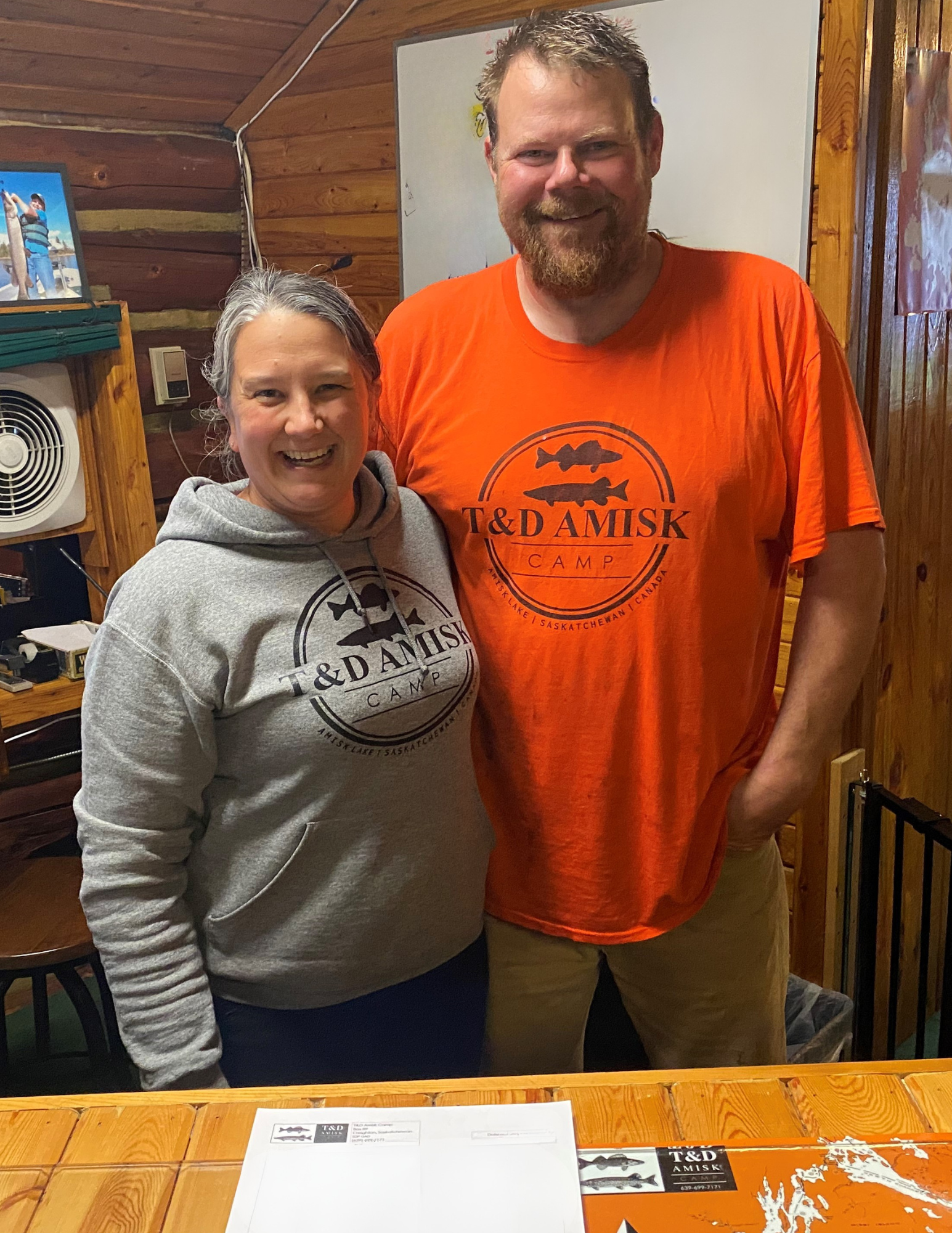
Since purchasing the business, they have strived to rejuvenate a decades long northern Saskatchewan business with a strong history. They have worked hard at renovating the camp while maintaining the core of its operation, and focusing on continuing to provide the exceptional customer service and northern hospitality it has always been known for. T&D Amisk Camp is a small operation, and you will find Cindy and Nick actively operating the camp on a daily basis, year round. In the summer, you will find Nick in the filleting house every evening going over the day while helping guests prepare their fish for eating or transport, around camp solving any of the myriad of wilderness camp maintenance tasks, or in the Lodge going over the lake orientation as guests arrive. Cindy will be behind the desk in the Lodge orienting new guests to camp and answering questions about the area, or anywhere around camp overseeing the day to day operations of the camp and cabins. When time permits, you may run into Nick out on the lake, ‘researching’ the best fishing spots, or me on a paddleboard for an evening retreat along the shoreline.
