


With over 35 years in the field, host Don Lamont covers topics and issues with industry leaders and influencers to bring you up to speed on what’s happening in the outdoor world.
And now, here is your host, Don Lamont.
Jordan Rowswell grew up on the family farm near Cutknife, Saskatchewan.
From here, he has been guiding hunters from around the globe for more than 20 years.
As a Saskatchewan Tourism Education Council certified hunting guide, he has enjoyed leading hunters to bear whitetails and waterfowl.
In 2019, a lifelong dream came true as he took over the family waterfowl hunting operation, his true passion.
Over the years, guiding for his father, Kevin, he has mastered where the birds feed, their natural flight lanes, and all of their resting spots.
Hey, Jordan, thanks for coming on The Complete Angler Podcast. Great to have you.
Good morning. How are you today?
Awesome. We hopefully get some nice weather here shortly across the prairies.
So, Jordan, where exactly are you located?
We operate just west of Cutknife, Saskatchewan, which is, in perspective, about two hours sort of northwest of Saskatoon.
Right. That’s on the other side of the Battlefords, just close to the Alberta border, right?
Correct. Yeah, we’re about a half hour from Alberta.
So, did you grow up there on a family homestead, or what’s the situation?
Yeah, you bet. I was born and raised on a mixed farm, so grain and cattle.
And that’s where we still operate out of to this day.
So, do you live there with your family?
I live east of the farm.
Okay.
Yeah, I still am involved with it.
I mean, we keep cattle and stuff like that, so.
The main reason, though, Jordan, I have you on the show, I was looking for somebody to talk to about spring snow geese,
and I was given your name by a friend, Rob Schultz, who is also a waterfall outfitter by Last Mountain Lake.
Do you know Rob?
Yep. Yes, I do.
Okay. And you said, well, spring snow geese can be a little tricky, which I totally agree with.
Yeah, and that has got to be one of the most frustrating things a human can do to himself, I think.
So, yeah, so anyway, we got talking, and you told me a story that you donated a spring snow goose hunt to some conservation officers.
Maybe you can tell me what happened there.
Yeah, so last year, I was approached by the Saskatchewan Association of Conservation Officers,
about donating a hunt to their annual convention.
I believe it’s some sort of fundraiser for them.
And I was all for it.
We chose to go with the spring snow goose hunt because my fall waterfowl hunts were booked up,
but I still wanted to give something to them.
So, that’s why we went with that, and it was awesome, man.
We had a conservation officer from Saskatchewan, actually, by the package.
And he came with a few buddies, and he flew out his dad from Ontario, who also was a conservation officer out there.
And, yeah, we had a blast.
Even me, I had fun doing it.
Well, I guess, you know, one of the keys on spring snow geese is the geese have to be there,
and you never know when that’s going to happen, do you?
No, and that was one thing that I wanted to, you know, keep in touch with them.
And sort of what I told them off the bat was, if it’s okay with you guys,
I would like to keep it sort of footloose and basically call you when the geese are here
to give the best opportunity at birds rather than pick a date out of thin air six months ahead of time
because I don’t know if there’s still going to be snow on the ground
or if the geese are even going to be here yet.
So, we kept it pretty loose, and we planned about, well, I don’t know, two weeks out.
And, yeah, the birds were here, and we had a good time.
Well, that sounds great, and I bet they went home very happy.
I’ve never seen grown men giggle so much, I don’t think.
It was a, yeah, it was a lot of fun.
Now, the interesting part of the conversation that I had with you
was the fact that you actually got to spend time with the conservation officers
and get a bit of an idea what they think and how you guys interact on the landscape.
Yeah, and, you know, I found it very interesting.
You get to kind of see the other side of the coin,
understand where they’re coming from on some issues,
and explain some of the issues on our end of things.
As you’re well aware, the waterfowl industry as a whole,
especially in Saskatchewan, is facing a lot of challenges.
And so, it was really neat to get a few days of FaceTime
with guys that share similar interests but are on, you know, different sides of it.
They’re on the enforcement side, obviously.
So, it’s kind of neat to explain to them, you know, what challenges we’re facing,
what we’re seeing in the field daily,
and what we can do to help them, I guess, in their enforcement role.
I also sit on the board for the Saskatchewan Commission of Professional Outfitters.
And so, it was, you know, we’re trying to go through some transitions, too.
So, it was really neat, like I say, to have that FaceTime with those guys
and be able to see it from different perspectives.
Right.
I guess the other hat that I wear, Jordan, is I’m the Executive Director
of the Manitoba Lodges and Outfitters.
And we went through a rather painful process with the waterfowl modernization policy.
But I think we’re reaping the rewards now as, you know, with an allocation,
the system that was put in place for non-resident hunters.
It’s, you know, the jury’s still out a little bit, but all indications are it was a fantastic result
after the first year.
A lot less pressure on the birds, on the landscape, spread out the hunting pressure,
and by all accounts, it was extremely successful.
So, I understand you guys are still working towards something like that.
Yeah.
And to be honest with you, I’m jealous in the fact that you guys actually got some movement
on this.
That’s one thing.
And, you know, I’ve been doing this a long time.
My dad started this outfitting company back in the 90s.
I started working for him about 2000.
So, I would guess that this is probably my 25th year guiding waterfowl hunters.
And the amount that it’s changed over the years is just sickening to me.
And, you know, I look at it as a resident perspective first.
You know, I live here year-round.
We operate here.
And, you know, it’s not just the outfitting, too.
It’s personal hunting as well.
You know, I’ve been a member of the Saskatchewan Wildlife Federation forever.
And the big thing for me is I would like to keep hunting,
waterfowl included, as it was when we were kids.
For my kids to enjoy.
Where you could just go out on a Saturday and ask permission to go hunt a field,
and it was given.
My biggest fear, like I said, as a resident first,
is my kids won’t have that opportunity in the future.
Unless we can figure out how to slow things down a little bit over here.
I think that was impetus here in Manitoba to get the regulation changes.
I know through the Manitoba Wildlife Federation,
it was really evident that residents were not getting access to any good hunting opportunities.
All the fields were spoken for and access was, it was really difficult.
So, definitely, Jordan, something had to change.
And it was a long time coming because this all started,
the waterfall modernization started in Manitoba in 2014.
They went through a process where they asked for people to report how many hunters they had had.
This is the outfitters over the course from 2015 to 2020.
And that was how their allocation was determined on what they reported as the number of hunters in camp
for those timeframes, those five years.
So, they came up with a number of 15,000 non-resident licenses.
And last year, they didn’t quite sell them all.
So, it seems to be a good number, a good balance.
And the thing about the waterfall policy we have in Manitoba is it’s flexible.
It can be changed.
It’s not set in stone.
So, I think that’s a key thing as well, don’t you?
Yeah, I would agree.
And picking a number like that, I mean, in Saskatchewan, it was, I believe the number was,
I want to say, about 11,500, give or take, non-resident licenses sold last year.
Okay.
The problem with it is, is we don’t know how many of those licenses went with outfitters
versus, you know, just a regular Joe coming up here hunting on his own.
Right.
So, we don’t know where those hunters went, who they hunted with.
I mean, they could have hunted with illegal outfitters, for all we know.
Right.
So, I like the allocation model in that you would be able to, I guess, to control the pressure,
spread it out a little bit.
Yeah.
And the other thing, Jordan, was they put a time limit on your license.
Correct me if I’m wrong.
I think it was a week or was it two weeks.
I can’t remember, but I should know that.
But so, so they eliminated illegal hunting.
So, you got your, so I’m a non-resident and I got my goose license.
And so, if it’s up after a week or two, then, you know, if I’m out there illegally guiding,
then, you know, it’s, you know, it’s easy to find out.
So, it’s easy.
Well, yeah.
Yeah.
And that was one thing we talked about last spring on this conservation officer snow goose hunt.
That those guys really like the idea of that because it gives some ability to them, some teeth to it to say,
listen, you know, your license was for September 15th.
Why are you still here on October 15th?
Exactly.
So, yeah, it makes sense from both sides on that one.
And I don’t think there’s nobody saying you can’t come by any stretch of the imagination.
It’s just, we’re trying to spread things out, I guess.
And I’m sure it was the same in Manitoba, but in Saskatchewan, especially in the last few years with a few droughts and that,
hunters follow the water because the birds are following the water.
So, there’s places, you know, like Quill Lakes.
I’m sure you’ve heard of that spot in Saskatchewan.
That is a hot spot.
I mean, you can’t throw a rock without hitting a bird over there.
So, there’s a ton of pressure.
And for locals, for outfitters, everything, it would be nice to just spread that pressure around the province a little bit.
There’s definitely other bird-producing areas in the province that could be hunted.
Right.
And that was a similar problem in Manitoba.
There was just a few hot spots and that was getting all the hunting pressure.
Yeah.
Yep.
But you’ve got some beautiful country out there for birds.
Isn’t it on one of the major flyaways?
Yeah, it is.
Yep.
And we’ve been very lucky that way in that, you know, we’re dead center.
We’re only really an hour’s drive from what you might call the boreal forest boundary.
So, as those birds migrate south in September, October, we’re kind of the first stop.
And the majority of them will stay here until they’ll freeze up and then they get pushed further south.
All right.
So, you’ve got the best of both worlds.
Yes.
I had a television fishing show for a number of years, Jordan, and one of them was up in Middle Lake.
So, I’m familiar with most of Saskatchewan.
I actually worked in Prince Albert for a couple of years.
And so, I spent a lot of time on the landscape in Saskatchewan.
And I know the country that you’re in is absolutely fantastic.
It’s a gorgeous country.
Like you say, right on the edge of Middle Lake Provincial Park there.
Beautiful country.
Yeah.
Yeah.
And honestly, we’ve definitely had our dry years here as well.
But there always seems to be the bigger bodies of water that’ll hold water longer.
So, other than in 2002, there was a major, major, major drought.
And I remember back then, well, dad had canceled most, if not all, of the hunts for that year just because of that.
Mm-hmm.
You also mentioned that, well, let’s talk a little bit about your dad and your mom.
They operate a different lodge, don’t they?
Yeah.
They’ve got a fly-in fishing and bear hunting lodge.
It’s on the Wheeler River system, 180 miles north of La Ronge, Saskatchewan.
Do you ever go and help them out with that?
Oh, yeah.
As often as I can, which isn’t often enough.
But it seems the last 10 years or so, I’ll go up and help with a bear hunt or two in June.
Well, let’s talk about spring bear.
We got on that topic as well.
And I mentioned that our spring bear outfitters in Manitoba seem to do quite well.
Most of them are usually booked three years in advance, so they don’t want to take money any further in advance than that in case allocations change.
But that’s kind of where we’re at.
So what does spring bear season outfitting look like in Saskatchewan, Jordan?
Well, I think it’s probably very similar to Manitoba in season dates and things like that.
And I’m not kidding you when I say we got a ton of bears over here.
One of the things that I’ve always found, however, is, and it could be just me, but the spring bear hunt can be a tough sell to people.
One of the issues I think at play there is once you shoot a bear or two in your life, you know, a lot of people quit or they get a lot pickier, things like that.
The other thing is almost everybody can shoot a bear in their home province or home state.
Right.
So it’s not necessarily that we’ve got something that nobody else has here.
You know, comparatively speaking to the waterfowl or something like that, where we’ve got these huge concentrations and you don’t see that, you know, anywhere else.
So, yeah, and like I say, once you shoot a bear or two, it’s not like you’re going to want one on your wall every year.
A bear rug takes up a lot of room.
It sure does.
It sure does.
Oh, I got bear stories.
The days of my lodge days, we had a, I was guiding up at Eagle Nest Lodge and managing the place and we had a big old black bear coming in the burn barrel and he said he was going to come in the main lodge, but we had to shoot him with a fire extinguisher is the only way we could discourage him.
So do you, you, you guide for bear, don’t you, Jordan?
That’s right.
Yeah.
Yeah.
Is it up at Wheeler?
No, no.
Uh, we run one, uh, down here as well.
Oh, okay.
Out of our bird camp.
Okay.
Well, I just didn’t see it on your website.
So you do offer it then.
Yes, sir.
Yeah.
That website, we’ve been talking for three years that we need to update that thing.
It’s tough to get sales if people don’t know that you offer it.
It’s true.
That’s my bad.
That’s funny.
Okay.
When does your bear season start?
Uh, we’ll be going here.
I think the first group is, uh, coming on the 28th of April.
Okay.
So, yeah, we’re starting to see a little bit of bear movement already, but hopefully in the next week or so here, when these temperatures come up, that’ll start moving pretty good.
Uh, how was your, uh, snowfall, snow situation this year?
It was, uh, it was weird.
We got a lot of snow early in the winter, but when it started melting, um, early March, there wasn’t a lot of moisture in it.
It didn’t seem like it was, uh, pretty, pretty crystal-y, sugary snow.
Right.
And then we got two big dumps of snow in late March, and that was, that held some water.
So now we’re starting to see some runoff here in the last few days, filling up potholes and things like that.
So we kind of narrowly escaped another dry spring.
Mm-hmm.
Yeah, that’s a good thing.
Yeah, we have similar here, but, uh, up north, I know to some of our operators, like at, uh, uh, Brian at Wacusco Falls Lodge, he, uh, they had four feet of snow still in the bush.
It was unbelievable the amount of snow they got.
Yeah.
Yeah.
I was, uh, I was quite far north in, uh, early March and it was same thing.
There was snow up to your belly button at that point.
Right.
Yeah.
So anyway, we do need the moisture.
Uh, we don’t have that much in Winnipeg where I, uh, where I live, but, um, we’re still waiting for those warm temperatures to arrive tomorrow, Jordan.
I’ll, I’ll start blowing east and send it your way.
Okay.
Well, this has been great.
Is there anything, uh, so, uh, you also are a licensed guide, are you not?
You took a course?
Yep.
Yep.
Through the, that time it was called the Saskatchewan Tourism Education Council.
Okay.
And, uh, what they offered was, I took the, the hunting guide course and the fishing guide.
It’s not necessarily, it’s not a license really.
It’s more just an education that you can present that, uh, I guess lets people know you’re not just a fly by night Joe.
Um, and it, it’s, it was a good program.
I mean, for example, the fishing one, it taught you everything from first aid and, and hypothermia and, and, uh, drowning incidents to, you know, how to deal with busted down boat motors.
So it just, I guess it’s one more thing to put in your tool belt, um, as far as some credibility goes for that sort of thing.
It’s not a requirement by any means, but, uh, yeah, I guess it just, it shows the customer that, that you’re invested in it and, and have some professionalism.
Um, I, I totally agree.
Well, we have a, a hunting guide licensing program, um, and you have to write the license with a conservation officer present.
Um, okay.
Uh, we don’t have anything on the fishing side.
And that’s one of the things that, uh, we’ve proposed to government as far as the Manitoba lodges and outfitters is we’d like to see an education program similar to that you have in Saskatchewan, especially on the fishing end of things.
Well, it, it just makes sense as far as I’m concerned, almost any industry you, you need to be trained for.
I don’t care if it’s, it’s hauling grain with a semi, uh, your nurses in the hospital better be trained or I’m not going there.
Right.
Uh, so why wouldn’t we be any different, I guess.
And, and even just to, to make sure that, that your guide knows the regulations and, and isn’t going to lead you astray out in the field.
Um, because those clients are coming here for the trip of a lifetime.
They’re depending on you to know the rules and regulations, not just where the animals and the fish are hiding.
Um, so it would be, you know, it’d be a terrible thing for a client to say, you know, how many fish can we put in the boat today?
And he goes, I don’t know, five, maybe 10.
I don’t know.
Wow.
So, I mean, that’s an extreme example, but, uh, yeah, it just, I think it should.
It’d be a, a little more widespread of a thing to, for people to do.
Yeah.
I’ve been lucky enough to, uh, um, be able to hunt with a waterfall with bird tail waterfall, a friend of mine, Paul Concharte, and, uh, they run a first class operation, fantastic guides, great experience, great accommodation.
And so we, we do have some, uh, across the prairies, we do have world-class outfitters.
There’s no doubt about it.
We do.
And, uh, I mean, Canada as a whole has something to offer the world.
And that is, that’s one thing that I will preach till my last breath is we are selling, in my case, we’re selling Saskatchewan to the world.
Um, and, uh, like I said earlier, I don’t want the quality that we had 15, 20 years ago, uh, to go downhill to the point where we don’t have a product left to show people here.
Um, and, uh, so yeah, we’re, we’re working on it.
Um, I know there’s a lot of, a lot of people invested in this, including, you know, the, the Saskatchewan Wildlife Federation is on board.
Um, government is listening.
We’re having some good quality conversation on, on how to, how to go about managing the waterfall industry in particular.
And ensure the longevity, longevity of it and still make it accessible for everybody.
So quality and, uh, longevity for the whole sector.
Well, I, uh, really would like to thank you for coming on, uh, my podcast, Jordan, today.
Uh, it’s, it’s been great, um, hearing your, um, story from Saskatchewan.
And, uh, I wish you all the best in getting the waterfall situation figured out in Saskatchewan.
Thanks a bunch.
I really appreciate it.
Good talking to you.
Thanks for tuning in.
Visit hookedmagazine.com to subscribe to The Complete Angler and never miss an episode.
12 Gauge Outfitting (formerly Big Sky Outfitting) is based at the family farm near Cut Knife, Saskatchewan – which just happens to be located in “Waterfowl Heaven”!
Jordan Rowswell grew up in the area and has been guiding hunters from around the globe for 20 years. As a Saskatchewan Tourism Education Council certified hunting guide, he has enjoyed leading hunters to bear, whitetails, and waterfowl. In 2019 a lifelong dream came true as he took over the family waterfowl hunting operation, his true passion. Over the years guiding for his father Kevin, he has mastered where the birds feed, the natural flight lanes, and all of their resting spots. He follows feeding patterns so that he knows when and where the birds will dump out of the sky.

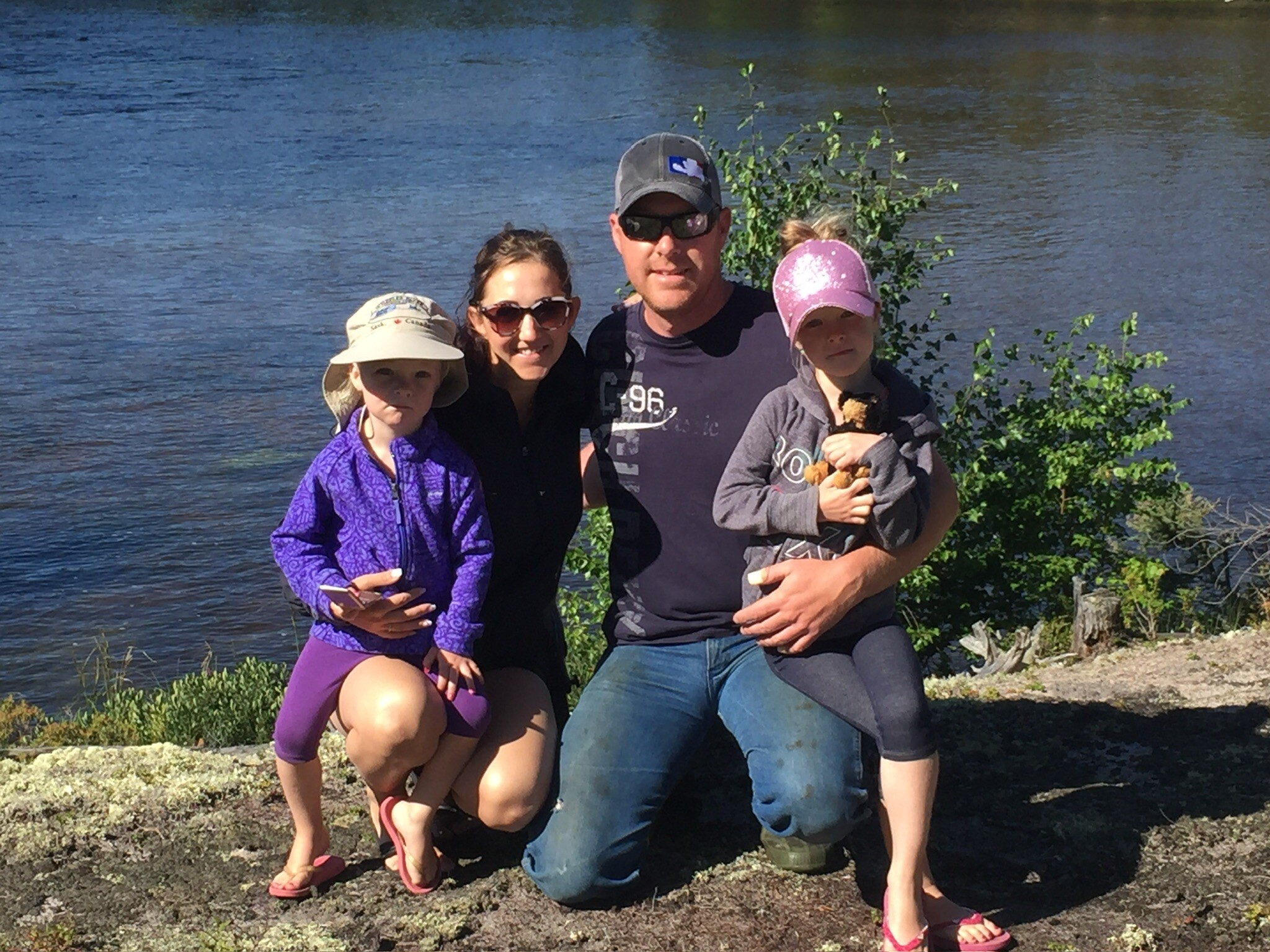
Jordan and Kendra Rowswell took over the family waterfowl operation in 2019. Jordan’s passion for hunting was passed on from his father who owns and operates Wheeler River Lodge. Together the Rowswell family has hosted hunters for over almost 30 years to their hunting and fishing operations.
Once the waterfowl season is over, you can still find Jordan outside; hunting, fishing, trapping, or pulling the kids behind a snowmobile.
