



With over 35 years in the field, host Don Lamont covers topics and issues with industry leaders and influencers to bring you up to speed on what’s happening in the outdoor world.
And now, here is your host, Don Lamont.
On today’s Complete Angler podcast, we visit with Alex (Alexandra) Schoen, the fish culture manager for the province of Manitoba.
Alex recently wrote an article on how wildfires will affect fish habitat in the future across the prairies.
A fascinating read in the 2025 fall issue of Hooked magazine.
Her research has taken her all over the world, eventually bringing her to Manitoba.
Hey, Alex. Thanks for coming on the Complete Angler podcast. Great to have you.
Thanks for having me, Don. I’m very excited to chat with you today.
Well, if there’s one thing I love to talk about, and that’s fish culture, fish biology.
I know your husband very well, Eric Mullin. We’ve had him on the podcast before.
Eric’s the regional fisheries manager in Lacta Bonny.
Now, when did you, first of all, congratulations on your new position, the fish culture manager for the province of Manitoba.
When did all this come in place?
Right. So I started this new position late January.
So I’ve been here, it’s actually, it doesn’t even feel like it’s, you know, kind of coming up on a year, but it’s almost coming up on a year, I guess, nine months, 10 months.
Prior to that, I was a postdoctoral fellow at the University of Winnipeg, studying with the province, projects with the province.
And so recreational angling, stress, mostly on lake trout and walleye.
And then prior to that, I did my PhD at the University of Manitoba, also in fish stress.
Fish stress.
So were you born and raised on the West Coast?
I saw that you have a lot of background with sharks.
No.
So I started those projects with sharks in my PhD.
So my PhD was looking at stress physiology of sharks, looking at energy metabolism as well.
I did a lot of cool work.
I had a lot of really amazing experiences on the West Coast, on Vancouver Island.
I was able to go to French Polynesia for a little bit and work on some endangered species down there.
But I actually was born and raised in Washington, D.C.
So I’m from the States, actually.
Went to school, did my undergrad in Maryland, worked in Florida.
I actually worked at Disney World for a little bit on their science team.
And then by just serendipitously, I was able to then make my way up to Manitoba after that.
Wow.
Well, we’re glad to have you here.
So let’s first of all talk about your new position.
What does that entail, being the fish culture manager?
Yeah, that’s a great question.
So primarily, as the fish culture manager, I’m responsible for just the fish culture programs within Manitoba.
So that includes our provincial hatcheries, of which we have two currently.
So we have our white shell hatchery in the eastern region.
That’s people can go there and visit.
There’s the interpretation center.
They do do tours at the white shell hatchery.
It’s a really cool place to see.
And then we have our swan hatchery, which is near the shores of Lake Manitoba.
And that is primarily a seasonal walleye hatchery.
So that is only operational during the walleye spawn.
Now, our fish culture spawning success and our hatchery has made Manitoba almost a world-class destination for stock trout, has it not?
Absolutely.
Absolutely.
Manitoba is absolutely world-class.
Not only from our stocked efforts, and that’s another really important part of my job, is running the stocking programs in Manitoba.
But also because of our attention to detail with our conservation efforts and our regulations within Manitoba and how what I really adore about Manitoba angling specifically is how passionate people are about it.
It’s really contagious.
It really gets you.
Everyone who comes here comes away realizing how much people care about the resource and how much people care about fish and how much it means to Manitobans in general.
So I think that’s part of the culture is part of it, too.
Yeah, I would agree with that.
Part of it has to do with the different programs that have been developed in the province, like the Master Angler Program, which a lot of people have totally bought into and want to see how many different species of Master Angler fish they can catch and register.
And it really has built up that conservation mosaic, I would think.
Do you agree with that?
For sure.
I absolutely agree with that.
I think that the Master Angler Program is something that is obviously unique to Manitoba, and it’s of an envy within Canada, and I think it goes beyond that, just envy within North America.
I participate in the Master Angler Program.
I actually, as soon as I got here, I moved here in 2018, and my, yeah, now husband and I, one of our first dates was going to Patterson, and we fished for rainbow trout and brown trout, and I had never seen a fish that big in my life.
I think the first fish I caught was a 24-inch rainbow, and that was one of my first masters I’d ever caught.
And since then, I’ve been participating in the Master Angler Program, and I know that it really means a lot to people, and it’s a cool way to be part of the conservation conversation, as well as just introduce people to fishing and expose people to just the natural resources in general.
We were also, and I’ve been in this business a long time, so since 1982, and I remember having a conversation at the time with Carl Wall when he wanted to bring in Barbless Angling.
Now this is, we’re going way back here, this is way before anybody else did, so I was there when they introduced that, and then I’m dating myself a little bit, and then Bill Bennett had the first catch and release lodge up at Newleton Lake, back probably in 19, I think it’s 1987, he brought that in.
And so it was around the middle and late 80s when all this was coming together, but the Master Angler Program has been around longer than that.
So when you culminate that with also the introduction of the Manitoba recreational angling strategy that was implemented two years ago, where you had limit reductions and the release of trophy fish.
What do you think all this has on the long-term conservation sustainability of the resource?
Right, so I think about conservation a lot.
My PhD was obviously focused on a different type of conservation, a dangerous species conservation, and mostly just stress.
And then, but that’s the thing that I think when people hear the word conservation, they, it’s not just about endangered species, it’s about making sure that species don’t get to that point.
And that’s something I think within Manitoba, with our, you know, barbless hooks, with the wreck angling package, everything that’s really come out in the last couple decades,
it, it, it, the focus is really making sure that we can provide this resource long-term and make sure that everyone has a chance to be exposed to this resource if they so choose,
whether that is recreational angling, commercial angling, harvest, whatever, whatever they need.
I think that’s a huge part of it.
So that’s, that’s part of the conservation angle, and then also just protecting our natural species.
So, for example, we have two native, major native trout species within Manitoba, so brook trout and lake trout.
So, another, another part of my job, which I am very grateful that I’m able to continue doing, is I’m an adjunct professor at the University of Winnipeg,
and I’m able to supervise students along with the help of the provincial fisheries to really study these species of conservation concerns.
So, brook trout, lake trout, walleye as well.
We do some walleye work.
So, yeah, I think we’re in a really good position right now with everything that’s come into the past,
and then now moving forward with doing research and figuring out where are the holes in our conservation efforts and how do we fix those.
I want to ask you about brook trout, because they’re, like you said, an incredibly valuable species to our province.
How are they doing?
How are the natural brook trout stocks doing?
That is such a great question.
I wish I had a better answer for you.
I would love to know.
So, our natural brook stock trouts are mostly in the north, and it’s hard to get there.
And I would love to be able to get there, and eventually I hope we will.
Yeah, that’s a question that I’m currently in talks with DFO about.
We’re trying to figure out exactly how the stocks are doing.
Currently, no concerns.
But, yeah, we’re looking forward to figuring that out in the future.
DFO is on board with, you know, things we’re doing.
Obviously, we’re on board with kind of mostly just investigative research right now to kind of see where the kind of the holes lie.
And I think primarily one thing that we’re studying with all of our trout species that is of importance is just climate change.
So, how are our trout stocks going to do under a changing climate?
It is getting warmer, and trout are very sensitive.
So, seeing how, what we can do to make sure that we have these species, even as the climate gets warmer.
Which leads me into my next question.
So, we discussed, you were interested in writing an article for Hooked Magazine, of which I’m the editor.
And we talked about different things.
One of them was fish disease.
And the other one was wildfire.
And you mentioned, well, let’s, we should focus on wildfire.
Because, given the season we just had here, and it’s not over yet, by the way, in Manitoba, I was blown away by the article you wrote.
I didn’t realize.
Thank you.
I thought we kind of, you know, I mean, the trees are burning, but the fish are okay.
So, maybe we could delve into a little bit on your article and your research you did for this.
Absolutely.
So, yeah, this year has been a pretty crazy year for wildfire in Manitoba, as well as just the rest of Western Canada, as everyone probably knows.
These fire years are in Manitoba, especially in Manitoba, especially in Manitoba, in the prairies, as well as in parts of the Shield, we do live in a fire-adapted environment.
So, there are species that need fire, so certain tree species, or just really opportunistic species, primarily terrestrial, that need fire in order to spread and reproduce.
However, those fires are usually low-intensity fires, and in the article, I kind of outline some of the things that low-intensity fires entail.
So, between, you know, between 200 and 400 degrees, low to the ground, there’s high humidity, lots of moisture, not a lot of fuel to burn as well.
So, that’s what our environment is used to.
However, when we get these really, really high-intensity fires like we did this year, it becomes a problem because the environment is not used to that.
And there’s actually physical changes that can happen, like the chemistry of the burn can actually change and create toxic chemicals, runoff problems, reduce the natural capacity buffer of the forests.
And then, a lot of these chemicals and nutrients and everything that’s coming off the land ends up in the water, eventually.
So, that’s where we get some impacts to aquatic systems, is when those things happen, when these high-intensity burns, we eventually get a rain, and then those chemicals end up in the water.
I saw a prime example of that.
I was up recently in northern Manitoba, Saskatchewan by Flin Flon Donair Beach, and I went past that Donair Beach burn.
And the intensity, the heat, you could see that it burnt down in the rocks, it melted the highway.
It was such a hot fire that it was just incredible.
So, there’s a prime example.
Everything was basically a wasteland.
And if you get rain then, everything, like you say, just drains back into the lake and into the stream.
So, yes, something to be aware of.
Let’s also talk a little bit about fish disease.
That’s a fascinating one for me.
Do we have a lot of that in our province?
Ooh, I wish I…
You don’t have an answer to that.
So, it’s interesting.
That’s a pretty broad question.
It is.
I do and I don’t.
I would like to know more.
So, another part of my job is I have done a lot of investigation into the listed fish diseases.
So, this would be federally listed fish diseases that affect our fish culture programs.
Primarily, these are viruses and bacteria that affect fish culture programs all over the world.
Manitoba is actually very lucky right now.
We have maybe a couple listed diseases that are now endemic to our province.
But we don’t have whirling disease currently, which is a big problem in the Rocky Mountains and Alberta.
We don’t usually have significant disease outbreaks that would be problematic from a fish culture perspective.
We do test our fish regularly as they’re coming out of the hatchery system.
So, we test them twice a year, actually.
And we’re very, very vigilant about testing and making sure we do not stalk diseased fish.
The diseases we are worried about are not a risk to humans at all.
But we are concerned if, you know, one of these diseases were to enter the ecosystem and then infect native species or other species of fish as well.
The more relevant, I think, diseases that people might be aware of are potentially dermal sarcomas of walleye.
So, those are when you catch a walleye and they have all those bumps and tumors all over them.
I see pictures all the time of people posting pictures of asking what those are.
And those are, again, not at risk to humans.
There’s no issue with them.
They don’t look great.
You may not want to eat that fish.
But it’s not a risk.
And it’s also, interestingly, not really a risk to the fish either.
So, it can become overwhelming eventually to the fish.
But usually it’s, you know, just old age at that point that the fish has an issue.
But they can live perfectly fine with those dermal sarcomas as well.
I’m glad you explained that because I get that, Alex, I got that question so much in my career.
And it’s really not fatal to fish.
And it’s just like a growth.
So, yeah, that’s great.
Now, recently, we’ve tried to introduce a species that we’ve kind of lost touch of for a while.
And that was muskie.
Do you see that as an interesting part of, are you involved in that?
I am.
I am.
So, yeah, we do have muskie.
One lake in our west side of the province, Wajask.
We’re looking at potential.
Where does this program go?
We have a student, actually, at the University of Winnipeg with Dr. Caleb Hassler.
So, he’s supervised by Caleb Hassler, who is actually looking at these muskie populations
and seeing the growth rates, how fast they’re reproducing, also doing a fingerprint study
where he’s taking pictures of these muskie and comparing them to master angler photos
to see if we can actually use master anglers as a kind of a citizen science way to collect
data on not only our muskie populations, but trout populations.
Really, really, any master angler fish would be great that has, like, a unique pattern.
So, trout would be great.
Muskie would be great.
So, he’s doing the work on the muskie.
And he just preliminarily has found that they are naturally reproducing in that lake.
So, we are getting naturally reproducing muskie.
As people probably know, there’s a lot more muskie than when there was a decade ago in that lake.
I think I forgot exactly the number we introduced in 2015, but there’s a lot more now, for sure.
Yes, for sure.
So, yeah.
So, it is a really cool opportunity for anglers to go out there.
It’s our one lake where we have muskie, and we’ll see where that goes in the future.
Speaking of the future, what would you like to accomplish in your next five years in your position?
That is a great question.
I think I have a meeting with my supervisor next week who is going to ask me the exact same question.
Well, good.
I’m prepping you for it.
Exactly.
Yeah.
So, I would really like to see, first of all, the health and success of our fish culture and stocking programs.
I think our hatcheries are absolutely core to that success, especially our trout hatchery.
For any of our stock trout species, it is absolutely essential to see the preservation and just the health in general of that hatchery and the health of the fish, too.
Like, we want to make sure that everything is running smoothly.
I would like to see some infrastructure updates in that respect at both of our hatcheries.
I think that would be really, really important.
We do have older hatcheries.
So, the white shell hatchery was built in the 1940s, and then the swan hatchery was built almost 100 years ago, over 100 years ago.
So, we have some pretty legacy hatcheries that are awesome, still do the job, but all over Canada, they are improving their hatcheries constantly.
And I think that’s a really good lesson that we can learn from other hatcheries in Ontario and Alberta, how to improve our stocks and make more fish, make better, more fish.
And then also, personally, just on the research side, I’m very research-driven.
It’s been, you know, the last decade, two decades of my life.
So, that’s something I’m really, really passionate about and making sure that we are conducting research that is beneficial to our stocking and our hatchery and our fish culture programs.
For the legacy of our fish culture program, as well as the conservation of our species.
So, just some work I did recently with the province was, with my postdoc at the University of Winnipeg, was looking at how recreational angling of lake trout is potentially impacting the next generation of fish.
So, if you angle females while they’re spawning, how is that going to impact their offspring?
And we published one paper on that so far.
We’re currently running the samples, or students at U of W are currently running the samples, and we’re going to publish another paper on that as well.
But the one, the first paper does point out that the stress response in the offspring of the lake trout that were angled does change.
So, they do change their stress hormone, which is also cortisol, same as humans.
We don’t know what that means.
It could mean that it might be bad for them.
It could mean that they are more prepared for a stressful environment.
So, it could go both ways.
We’re hoping to answer some of those questions, not only in lake trout, but in our other trout and walleye species as well.
We do have some walleye samples, too, that we’re going to look at, too.
Fascinating work.
Yeah, I’ve been reading some of it.
It’s really great stuff.
So, final one before I let you go.
What is your favorite fish to fish for?
Because I know you’re a hardcore angler.
That’s also a really hard question.
I do love trout.
I love stock trout.
I feel like I have to.
And also, they’re just so much fun to fish for.
But I think, as you know, my husband’s pretty obsessed with burbot.
I think I have to also say burbot because they’re such a unique…
They’re so unique.
They put up a really good fight.
They look like no other fish ever.
They’re, you know, a freshwater cod, basically.
They’re amazing to eat.
We had…
We’ll cook it in butter, but we’ll also cook it, like, Mediterranean style with burbot on top of tomatoes and feta.
It’s really, really good.
Even fried, it’s good.
We put in a pasta before, like, substitute lobster in a pasta and just put burbot.
It’s delicious.
So, that’s probably one of my top up there.
And then, yeah.
And then the trout as well.
I just have to just love all trout.
Well, Alex, it’s been a pleasure having you on the show.
And good luck in your new position.
And I look forward to some of your articles in the future in Hooked Magazine.
Absolutely.
Thank you so much, Don, for having me.
And I really appreciate the opportunity.
You’re welcome.
Thanks for tuning in.
Visit hookedmagazine.com to subscribe to The Complete Angler and never miss an episode.
Alex is the Fish Culture Manager for the Province of Manitoba. She moved to Manitoba for school and has been ‘hooked’ ever since. She has a PhD in fish and shark physiology, with an emphasis on fish stress. She most recently served as a post-doctoral fellow at the University of Winnipeg. Her post-doctoral work focused on the impacts of recreational angling on maternal stress in lake trout and walleye. The study was designed to find out catch and release and angling during the spawn affects offspring. The final data is pending but maternal stress seems to change the stress response in baby lake trout.
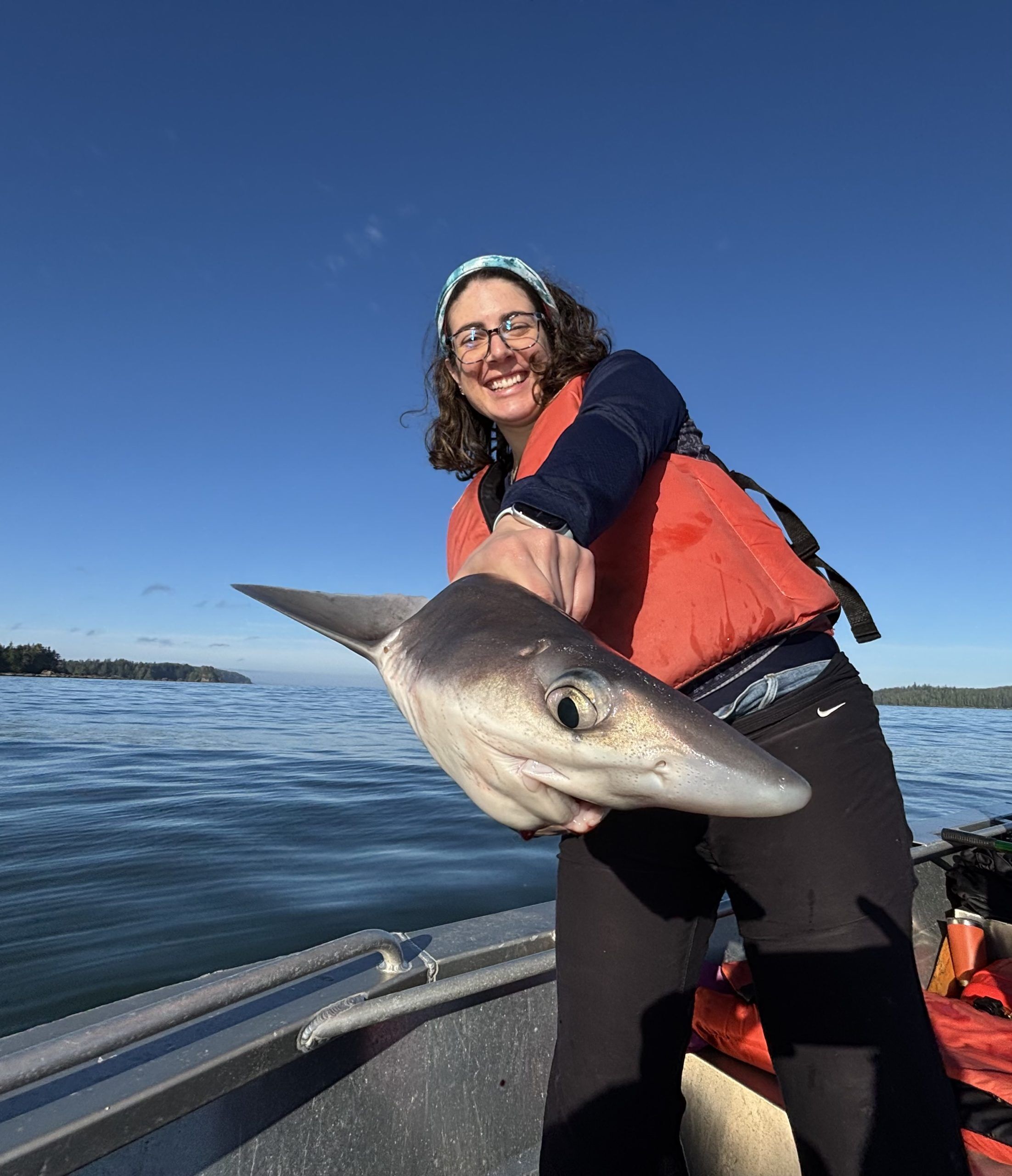
Going fishing and raising baby fish were the best parts of her research, but when not fishing at work, she enjoys fishing for fun, especially for stocked trout and burbot.
