


STRATEGIES ON ICE
Ice fishing has come a long way from the old-school methods of hand drilling holes and waiting for a bite on an upside-down pail. Innovations in technology have made the sport fun and enjoyable. After all, ice fishing does make the winter go by that much quicker. The lithium battery is the single most important technology advancement that makes modern ice fishing possible. Light weight electric augers allow us to effortlessly punch holes and stay on fish, while live sonar-GPS systems help us “unlock” the lake from the ice surface.
The popularity of hardwater angling across the ice belt has grown exponentially. Over the last few years, sonar technology has evolved to meet the demand. Navigating under the ice can be challenging with a traditional 2D flasher. Back in the day, we would run and gun a lot to eliminate or find productive water. In the modern ice age, the flasher still has its time and place but some days you just need that special tool. Angling pressure comes to mind.

High-definition GPS contour lake maps such as Lakemaster VX in conjunction with forward facing sonar (FFS) have changed the game providing real-time, detailed underwater imagery. We can find fish in minutes and equally eliminate areas not worth fishing. One of the primary advantages of FFS is its ability to see exactly what the fish are relating too and their behaviour. Last March, we found largemouth bass mulling around boulders off a main lake point.
On Lake Winnipeg for example, we watched a walleye plow into a cloud of shiners on MEGA Live 4 feet under the ice. Super Cool. Instead of drilling multiple holes in search of fish, one hole and a quick scan of 80 feet in forward mode can tell us the story. This efficiency not only saves us time but also increases the likelihood of finding active fish.
Strategies – Sniping Individual Fish

What’s that famous saying? “If you’re not scoping your hoping”. Most people that I see on the ice use their live sonar as a flasher. They camp out on the ice, set up the shack, position the live unit in down mode and watch fish react to their presentation. There’s absolutely nothing wrong with that. To use the technology to the fullest, it requires work and lots of it. This is where the lightweight and speedy ION alpha comes in. We have done it for greenbacks and crappies with success. Targeting individual fish is a lot easier in the boat when you can stay on the trolling motor and follow the fish around.
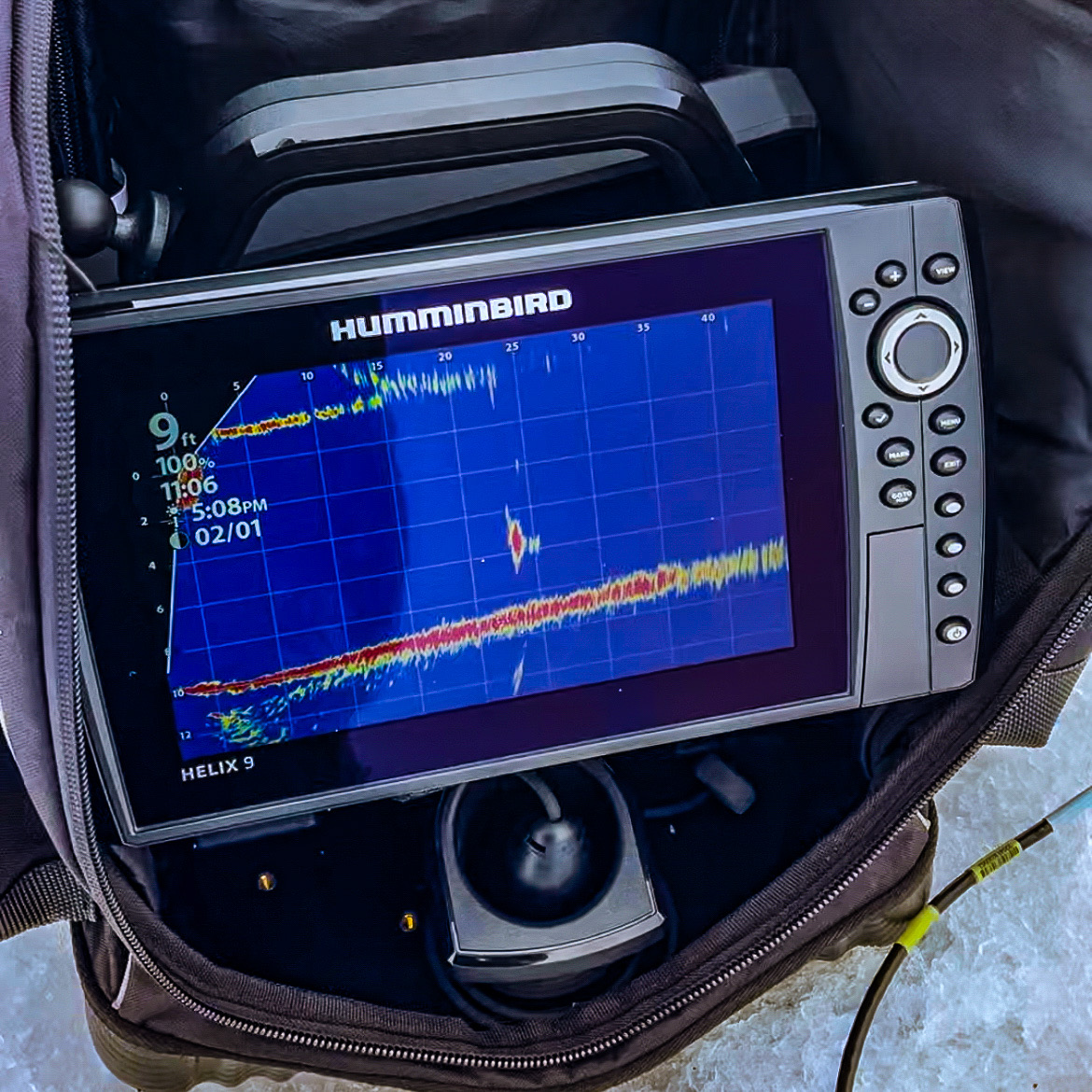
Setting up the MEGA Live transducer correctly is important for sniping fish. The sonar beam needs be positioned higher in the water column to see the auger punch through. A range of 50 feet with a transducer angle of 50/60 degrees forward is optimal. After some practice, you will get a good idea where to drill the hole distance wise from the transducer pole. The MEGA Live sonar beam is narrower than you think; you need to be perfectly inline to see targets. Punching a few holes in a grid pattern around the transducer hole in all directions is a great starting point.

Two winters ago we were out on Lake Winnipeg with our good buddy Jake Caughey from the states. Jake fishes on the National Walleye Tour and cashes in on a lot of derbies in Minnesota. The weather was decent, and we fished outside as a team from sunup to sundown. One person would pan around with the transducer pole while someone would stay mobile with the auger. The person at the Helix screen would coach whoever had a line down. We chased Greenbacks all around the lake. Every fish we caught that day didn’t make it close to the transducer hole. We went through four auger batteries and Jake was recharging his pistol bit batteries in between spots.
The FFS Beam Effect
One of the greatest mysteries of the FFS era has got to be: Are fish spooked by the sonar beam intensity? A lot of anglers on Lake Winnipeg have reported scenarios where fish swim up to the 30-foot mark, hit the beam, and turn around the opposite direction. We will never know the true answer to the question. Some days, the fish are aggressive and don’t care. Depth appears to have an impact as well. Crappies suspended over a deep wintering basin seem to be less affected in comparison to a school of crappies cruising a shallow mud flat. We have also seen crappies in the Whiteshell spook from the auger on FFS while hunting down the schools. All fish feel vibrations down their lateral line. Does the beam have a negative effect on neutral fish activity? Only the fish know.
MEGA 360 Imaging
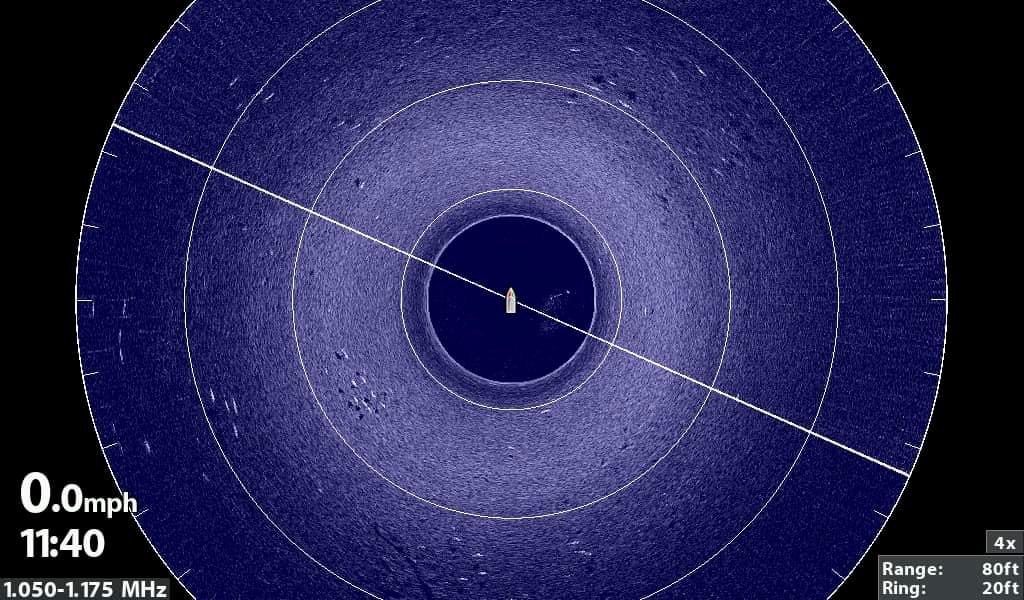
Another useful piece of technology for the ice is Humminbird MEGA 360. The transducer mechanically turns 360 degrees and produces a sonar image that shows you the “lay of the land”. This sonar is not live, but you can do a quick scan and see fish and structure 80 feet away in any direction in relation to your position. A few of the guides on Lake Winnipeg have been using this technology the last couple seasons to quickly find good areas holding walleyes. Since most of the areas we fish in the south basin are flat consisting of mud, sand, and gravel; walleyes stick out like a sore thumb on MEGA 360. Just like side imaging in the boat, look for the sonar shadow. Large walleyes will give off a larger shadow and vice versa. Another quick effective tool for covering water on the frozen tundra of big windy.
Sniping fish on forward facing sonar can be a fun way to bring fish topside. Try it out this winter on a nice fishable day outside. The pure amount of information gained from FFS is invaluable. Whether you’re a seasoned pro or a novice, incorporating forward facing sonar into your ice fishing game is worth the investment. I hope everyone stays safe this winter and always be cautious on first ice. Let’s hope for a good freeze this year. Always take safety precautions. Wear your ice picks and use a spud bar on thin ice. See you on the hardwater.
